As an Amazon Associate I earn from qualifying purchases. This page contains affiliate links, and I may earn a commission at no extra cost to you.
Trying to work from a coffee shop, airport gate, or train table without an outlet in sight used to mean prioritising which gadget got to survive the afternoon. Today's high-wattage power banks have eliminated that triage. If you pack the right brick, you can juice a demanding 16-inch laptop while topping up your phone and wireless earbuds simultaneously.
Yet, buying a multi-device battery pack comes with specific pitfalls. Marketing materials love to boast combined wattage figures that obscure how power actually splits across ports. A charger advertised as '145W' might only deliver 100W to your primary device once you plug in a secondary phone. To save you from flat-battery surprises, this guide breaks down published specifications, port allocations, and user experiences across three leading heavy-duty portable chargers.
Quick Comparison Table
| Product | Battery Capacity | Max Output | Form Factor | Best For | Link |
|---|---|---|---|---|---|
| Anker 737 Power Bank (PowerCore 24K) | 24,000mAh | 140W | Upright Brick | High-wattage real-time monitoring | Check today's price on Amazon |
| Baseus Blade 100W Power Bank | 20,000mAh | 100W | Ultra-slim Flat Deck | Slim laptop bags & commuters | Check today's price on Amazon |
| UGREEN 145W Power Bank 25000mAh | 25,000mAh | 145W | Pill Slab | Maximum capacity & twin-laptop sharing | Check today's price on Amazon |
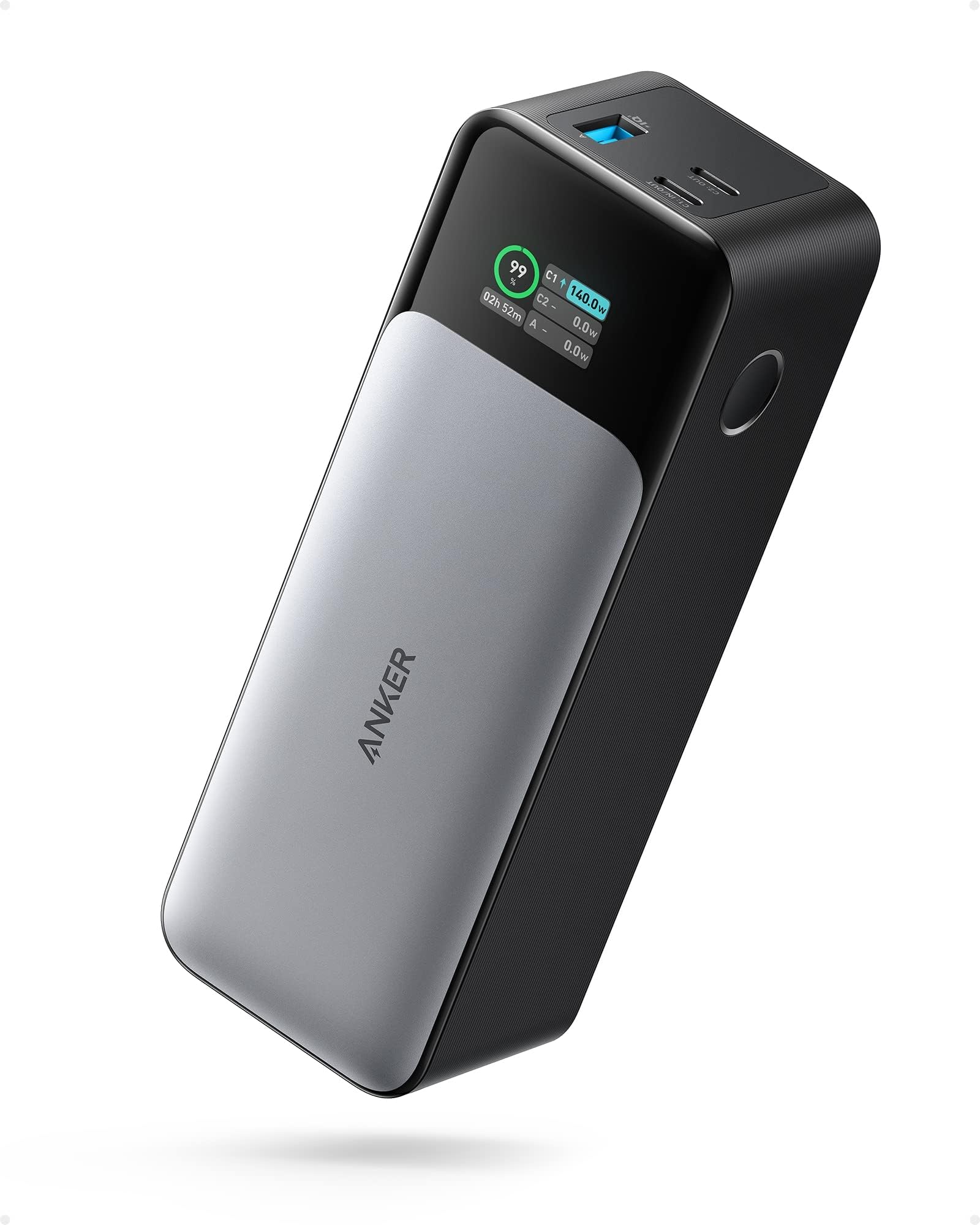
Anker 737 Power Bank (PowerCore 24K): The Smart Screen Powerhouse
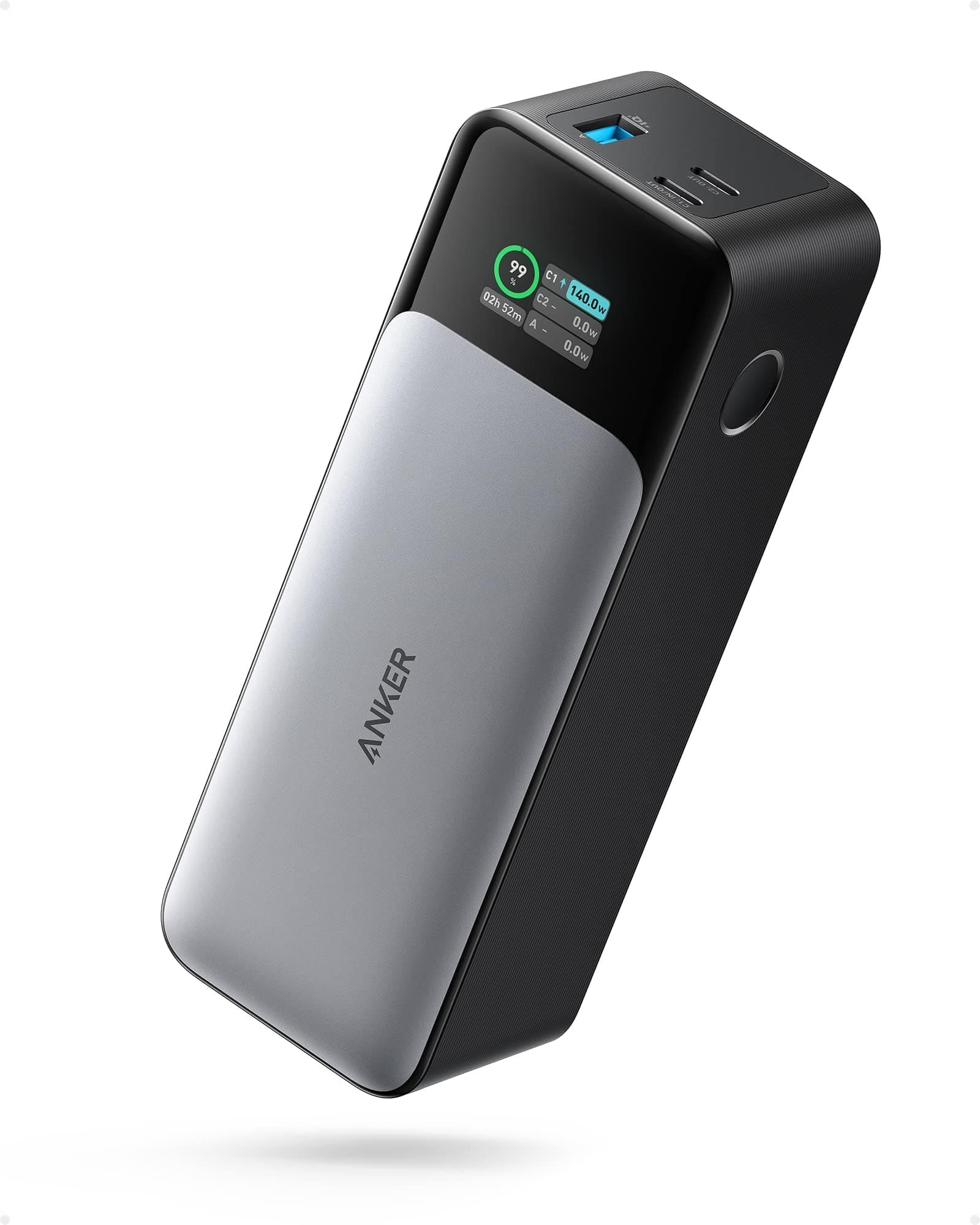
The Anker 737 Power Bank has established itself as a benchmark for mobile power users. It packages a substantial 24,000mAh cell capacity with modern Power Delivery (PD 3.1) architecture, capable of pushing a blistering 140W through a single USB-C port. That is enough headroom to charge demanding machines like a 16-inch MacBook Pro or power-hungry Windows workstation at near-maximum wall speeds.
What sets this unit apart from generic power bricks is its full-colour intelligent display. Rather than relying on four ambiguous LED dots, the screen provides granular, real-time telemetry: incoming and outgoing wattage per port, overall battery percentage, internal temperature, and an estimated time-to-empty based on current power draw. For tech enthusiasts who want to verify that their laptop is negotiating the correct fast-charging protocol, this screen eliminates guesswork.
Key Features & Performance Specs
- Two-Way 140W Fast Charging: Equipped with bi-directional PD 3.1 technology, allowing you to discharge at 140W or fully replenish the internal 24,000mAh battery in well under an hour when paired with a compatible 140W wall adapter.
- Port Setup: Two USB-C ports alongside one legacy USB-A port. It comfortably powers a laptop and two accessories at once, with an iPhone 13 receiving nearly five full charges on a single bank reserve.
- Thermal Monitoring: Anker's proprietary ActiveShield 2.0 temperature monitoring checks thermals millions of times per day to prevent overheating during sustained peak loads.
The trade-off is physical bulk. Its upright, soda-can-style profile does not slide easily into a slim briefcase pocket, and weighing around 630 grams, you will definitely feel it in your backpack.
Baseus Blade 100W Power Bank: The Slim Briefcase Companion
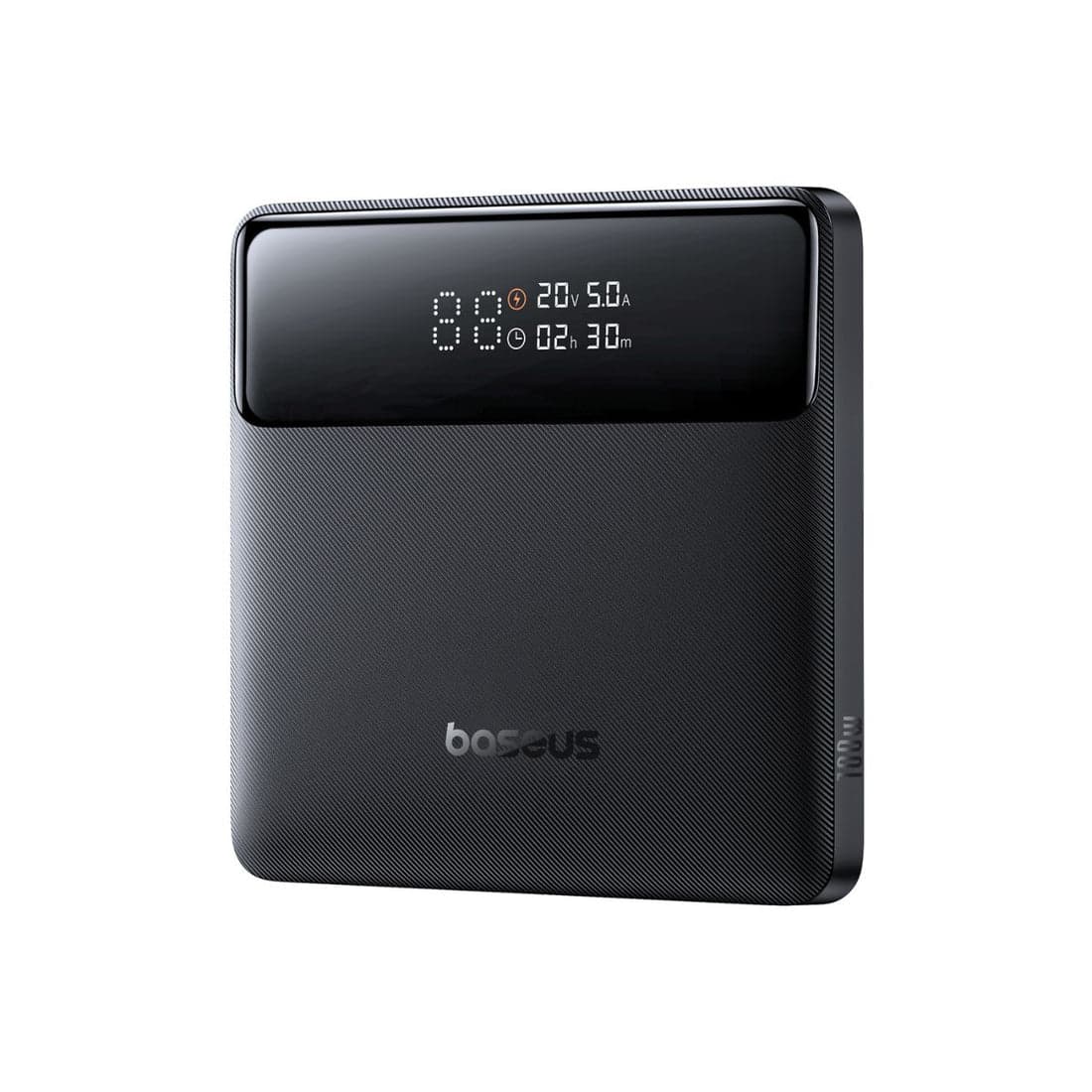
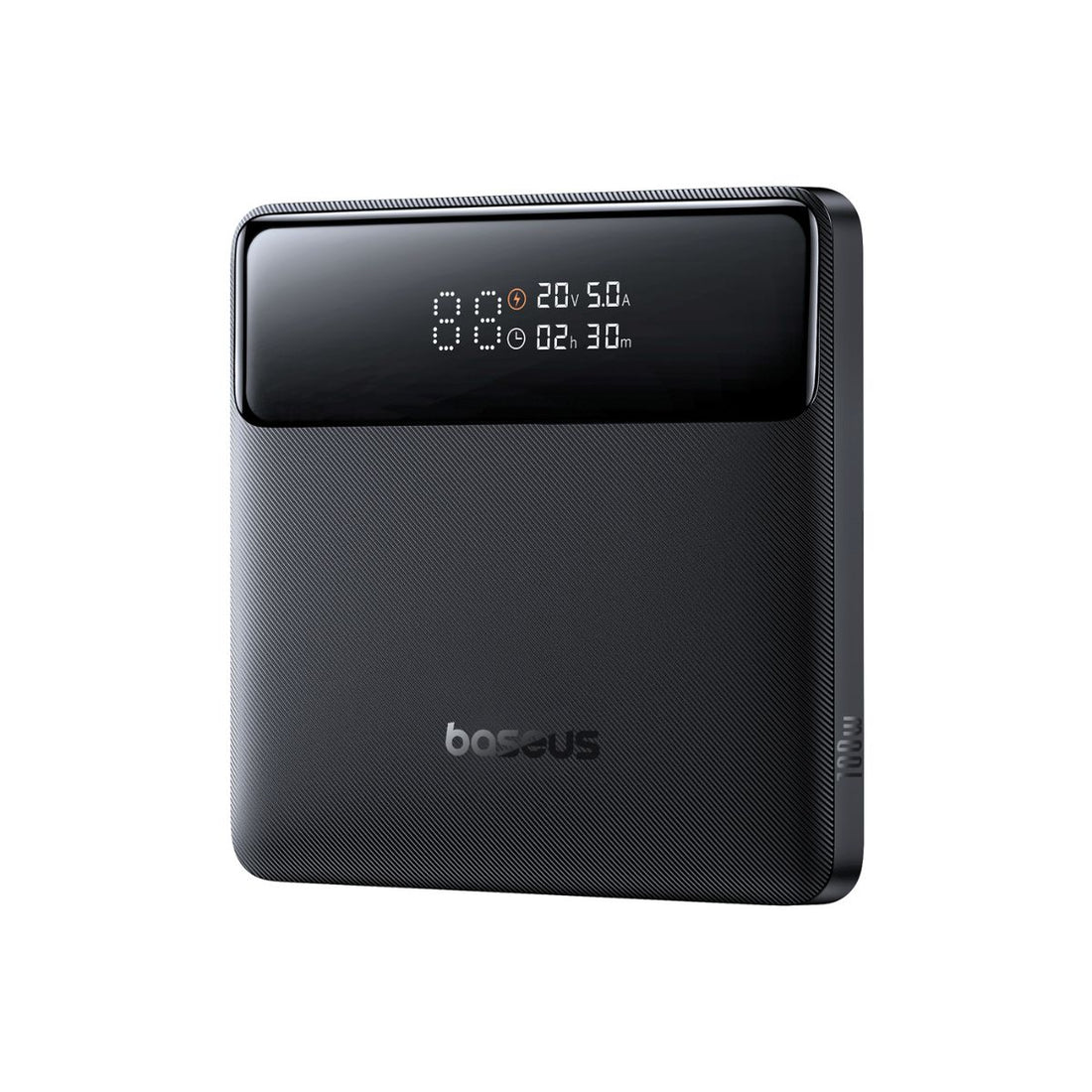
Traditional high-capacity power banks tend to be thick, chunky cylinders that create unsightly bulges in laptop bags. The Baseus Blade 100W Power Bank rejects that form factor entirely. At just around 18mm thick, it adopts a flat, book-like silhouette designed specifically to slide into the dedicated tablet or document sleeve of a briefcase or backpack.
Despite its ultra-thin profile, the Blade provides a 20,000mAh capacity and a 100W maximum USB-C output. That enables it to take a standard MacBook Pro from empty to roughly 50% in approximately 30 minutes, or provide 3 to 4 full top-ups for modern smartphones such as the iPhone 16 Pro. It is fully FAA-compliant and TSA-approved for air travel, making it an ideal companion for transcontinental flights where you need to work uninterrupted without an under-seat plug socket.
Key Features & Performance Specs
- Quad-Port Layout: Features two USB-C ports and two USB-A ports, making it one of the few flat-profile chargers able to service four devices at the same time.
- Digital Status Display: A clean digital screen reveals remaining battery percentage, real-time charging voltage/current, and calculated time remaining until empty.
- Safety Certification: Integrated protections against overcharging, overcurrent, and thermal throttling certified under rigorous UL and IEC safety standards.
Because of its flat, wide surface area, the Baseus Blade can get warm to the touch when sustaining full 100W output for extended stretches. Additionally, its maximum single-port limit is 100W rather than the newer 140W standard, which is more than enough for 13-inch and 14-inch laptops but marginally slower for flagship 16-inch workstations under heavy load.
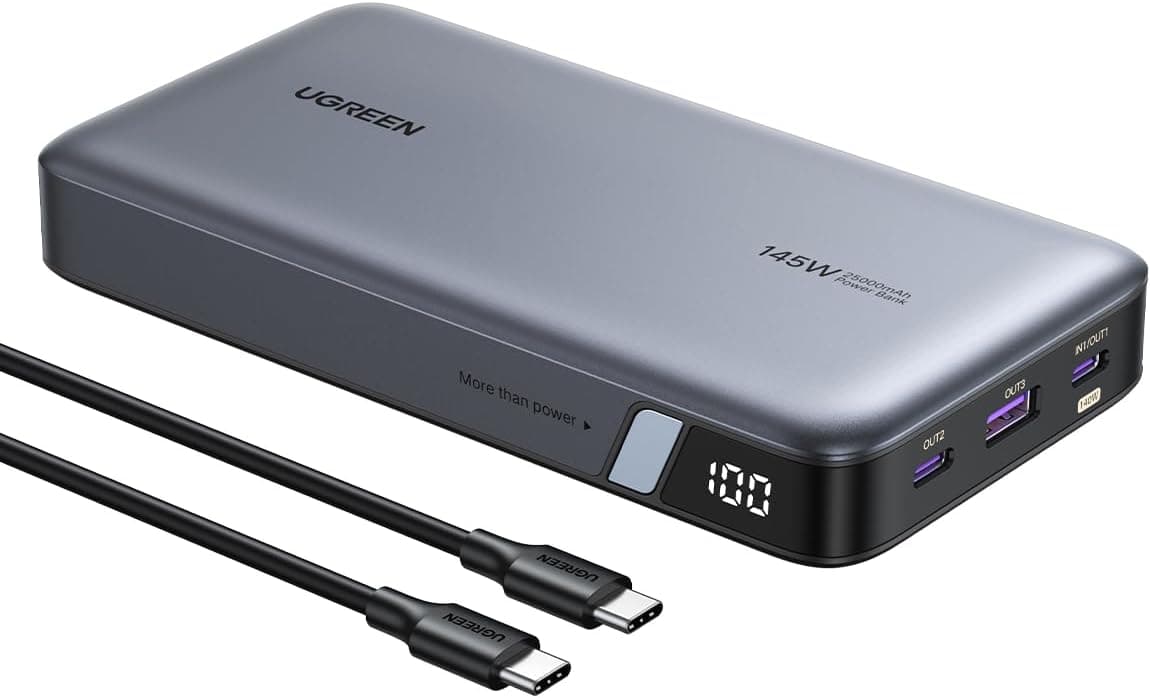
UGREEN 145W Power Bank 25000mAh: The Heavy-Duty Multi-Tasker
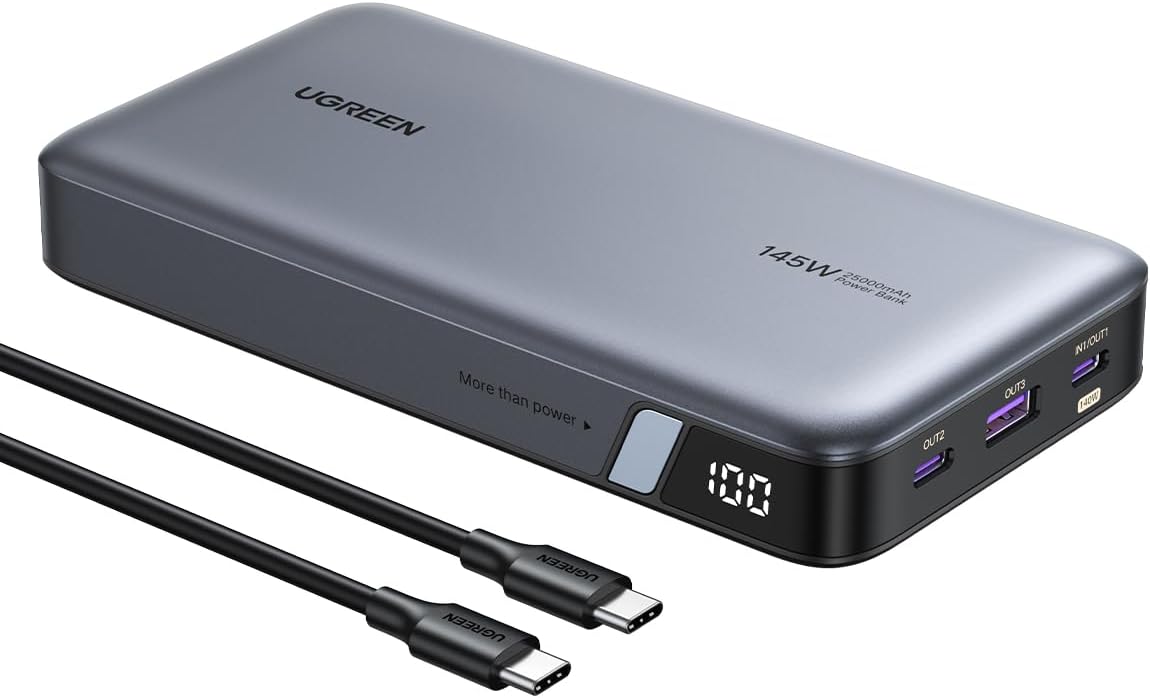
If your daily carry involves multiple high-drain devices—such as a work laptop, an iPad Pro, and a secondary phone or Steam Deck—the UGREEN 145W Power Bank 25000mAh offers the best balance of raw capacity and split-power intelligence. Housing a massive 25,000mAh battery, it sits right at the legal limit for international airline carry-on regulations.
The headline feature here is multi-port power allocation. The primary USB-C1 port can push up to 140W on its own using PD 3.1. When two devices are connected across both USB-C ports, the bank dynamically splits power to deliver 100W to your primary laptop and 45W to a second laptop or tablet simultaneously. That makes it uniquely practical for collaborative working sessions where two people need genuine fast charging at the same time.
Key Features & Performance Specs
- 145W Combined Output: Powers a 16-inch MacBook Pro up to 56% in roughly 30 minutes via single-port 140W delivery, or splits wattage smoothly across connected gadgets.
- Rapid 2-Hour Recharging: Supports 65W fast input charging, allowing the entire 25,000mAh capacity to replenish from flat in about 2 hours when paired with an appropriate 65W+ wall plug.
- Broad Protocol Support: Supports PD 3.1, Quick Charge 3.0, and standard protocols across brands including Apple, Dell XPS, HP Spectre, Samsung Galaxy, and the Nintendo Switch.
UGREEN equips this unit with a simplified segmented digital percentage readout rather than an extensive graphical display. It tells you exactly how much juice is left, though it lacks the advanced watt-meter diagnostics found on the Anker 737.
Alternatives to Consider
Depending on your travel habits and gear pouch requirements, the big three above might offer more capacity or weight than you strictly need:
- For ultra-portable daily commutes: If you only need to keep a phone and tablet alive without lugging a half-kilo battery, look at standard 10,000mAh to 15,000mAh compact bricks with 30W output, which fit easily in a coat pocket.
- For week-long off-grid camping: If you are looking to power mini-fridges, drones, or CPAP machines away from mains power, skip portable pocket power banks entirely and consider a dedicated 256Wh+ portable power station with integrated AC wall outlets.
Buyer's Guide: What to Look For in a Multi-Device Charger
Understanding Port Wattage Splits
Never rely solely on the total wattage advertised on the box. A '145W' battery bank rarely outputs 145W from a single port; instead, that figure typically reflects the maximum simultaneous output across two active ports (such as 100W + 45W). Always verify the single-port maximum wattage to ensure it meets your laptop's baseline charging requirements.
Airline Regulations (Watt-Hour Limits)
Aviation safety authorities generally restrict lithium-ion power banks in carry-on luggage to a maximum capacity of 100 Watt-hours (Wh) without prior airline approval. A standard 20,000mAh to 25,000mAh power bank (operating at nominal cell voltages around 3.7V) translates to roughly 74Wh to 92.5Wh, placing all three models featured in this guide safely beneath the standard 100Wh ceiling.
Recharge Speed Matters
A massive 25,000mAh capacity is only convenient if you can refill it quickly. Ensure any high-capacity bank you purchase supports at least 65W input recharging. A basic 10W phone charger will take over 12 hours to replenish a dead 24,000mAh battery, whereas a 65W PD charger does the job in roughly two hours.
Final Verdict
For most commuters and remote workers juggling multiple demanding electronics, the UGREEN 145W Power Bank 25000mAh takes our top recommendation. Its generous 25,000mAh cell ceiling and practical 100W + 45W simultaneous split deliver genuine dual-device laptop charging without unnecessary compromises. If you prioritise a slim profile above all else, the Baseus Blade 100W Power Bank is the easiest to slide into a briefcase, while data lovers will appreciate the comprehensive screen on the Anker 737 Power Bank.