As an Amazon Associate I earn from qualifying purchases. This page contains affiliate links, and I may earn a commission at no extra cost to you.
Choosing Between Minimalist Compacts and Feature-Packed Flagships
Action cameras used to follow a strict formula: a small rectangular box, a tiny screen on the back, and a couple of buttons. Today, the category has split into distinct sub-genres tailored to very specific filming styles. On one end, you have ultra-compact, stripped-down cameras designed to be mounted and forgotten—like GoPro's screenless Mini format. On the other, you have full-sized flagship powerhouses loaded with dual OLED touchscreens, massive sensors, dynamic range processing, and direct wireless microphone integration.
If you are trying to capture high-speed downhill mountain biking runs, chest-mounted motorcycle commutes, or extreme water sports, choosing the wrong form factor leads to quick buyer's remorse. A camera with dual touchscreens is fantastic for framing vlogs on the go, but those glass displays represent extra failure points if you routinely crash into gravel. Conversely, a screenless action camera saves weight and bulk on a helmet, but forces you to rely on a smartphone app just to check your framing or adjust frame rates.
This guide breaks down three top-tier action cameras available today: the compact GoPro HERO11 Black Mini, the feature-rich DJI Osmo Action 5 Pro, and the AI-assisted Insta360 Ace Pro 2. We compare their published specifications, battery longevity, mounting versatility, and low-light imaging capabilities to highlight which model truly fits your specific recording needs.
Action Camera Comparison at a Glance
| Camera Model | Key Sensor / Video Spec | Form Factor & Display | Price Band | Primary Advantage | Where to Buy |
|---|---|---|---|---|---|
| DJI Osmo Action 5 Pro | 1/1.3" Sensor, 13.5-Stop Dynamic Range, 4K Resolution | Dual Ultra-Bright OLED Touchscreens | Mid-Range Flagship | 4-Hour Battery & Direct Wireless Mic Integration | View on Amazon |
| GoPro HERO11 Black Mini | 5.3K Video, 8:7 Aspect Ratio, HyperSmooth Stabilization | Screenless, Dual Mounting Fingers (Bottom + Back) | Budget / Mid-Range | Ultra-rugged, aerodynamic shape for helmets & tight rigs | View on Amazon |
| Insta360 Ace Pro 2 | 4K60 Active HDR, Lossless Zoom, Advanced AI Processing | Flip-Up Rear Screen, Modular Grip Compatibility | Premium Flagship | Endurance battery potential & versatile framing controls | View on Amazon |
GoPro HERO11 Black Mini: The Bulletproof Aerodynamic Minimalist
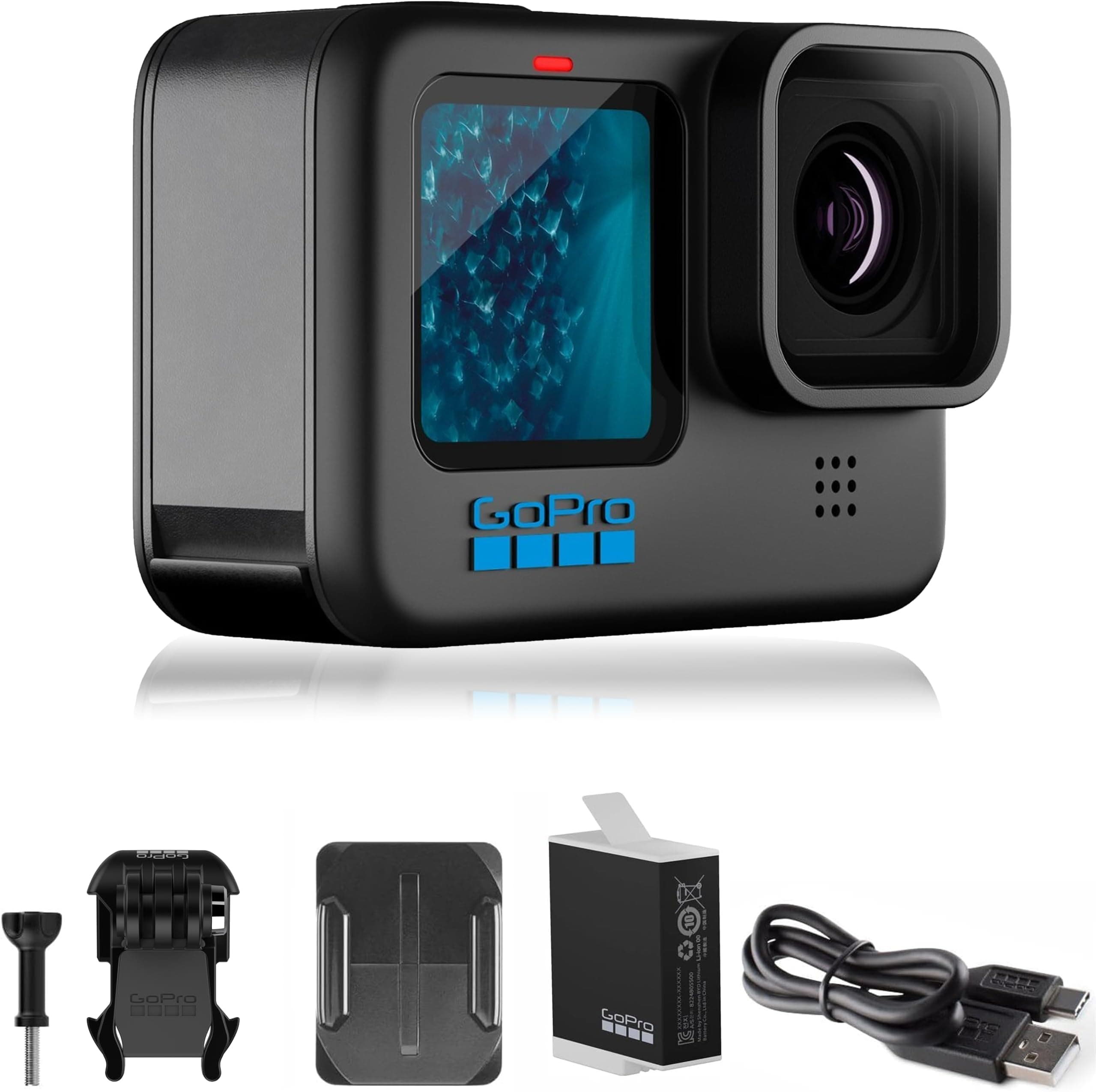
The GoPro HERO11 Black Mini was built for one primary purpose: high-impact action sports where external screens are an expensive liability. By omitting both the front preview screen and the rear touchscreen display found on standard GoPro flagships, the Mini shrinks its frontal surface area and delivers a tough, rubberized shell capable of taking serious abuse. Included in the package are the HERO11 Black Mini camera, a protective carrying case, a curved adhesive mount, a mounting buckle with thumb screw, and a USB-C charging cable.
Design & Mount Versatility
What sets the Mini apart from standard action cameras is its dual set of folding mounting fingers. You get standard mounting fingers on the bottom, plus an extra set built directly into the rear housing. This subtle engineering choice solves a massive pain point for helmet mounts and chest harnesses. On standard cameras, mounting to a full-face helmet often requires right-angle adapters or offset arms that add leverage and vibration. The rear fingers allow the camera to sit virtually flat against a helmet chin bar or chest plate, significantly improving aerodynamics and reducing neck strain during long rides.
Performance & Practical Trade-offs
Internally, the HERO11 Black Mini uses the same 8:7 aspect ratio sensor found in GoPro's full-sized 11-series flagship. This square-ish canvas lets you shoot in high-resolution 5.3K and crop later into vertical 9:16 video for mobile platforms or horizontal 16:9 for traditional displays without sacrificing stabilization headroom. GoPro's HyperSmooth stabilization keeps horizon lines locked even during heavy vibration.
However, going screenless requires compromises. Mode switching and settings adjustments must be done either via a tiny top status LCD using short and long button presses, or by pairing the camera with GoPro's mobile app. If you frequently change frame rates or digital lenses throughout the day, the lack of a proper touchscreen can quickly become frustrating. Furthermore, the battery in the HERO11 Black Mini is internal and non-removable. Once depleted, you must plug the camera into a USB-C power bank rather than swapping in a fresh battery—a critical detail for full-day festival recording or back-to-back ski runs.
DJI Osmo Action 5 Pro: The Unmatched Flagship Workhorse
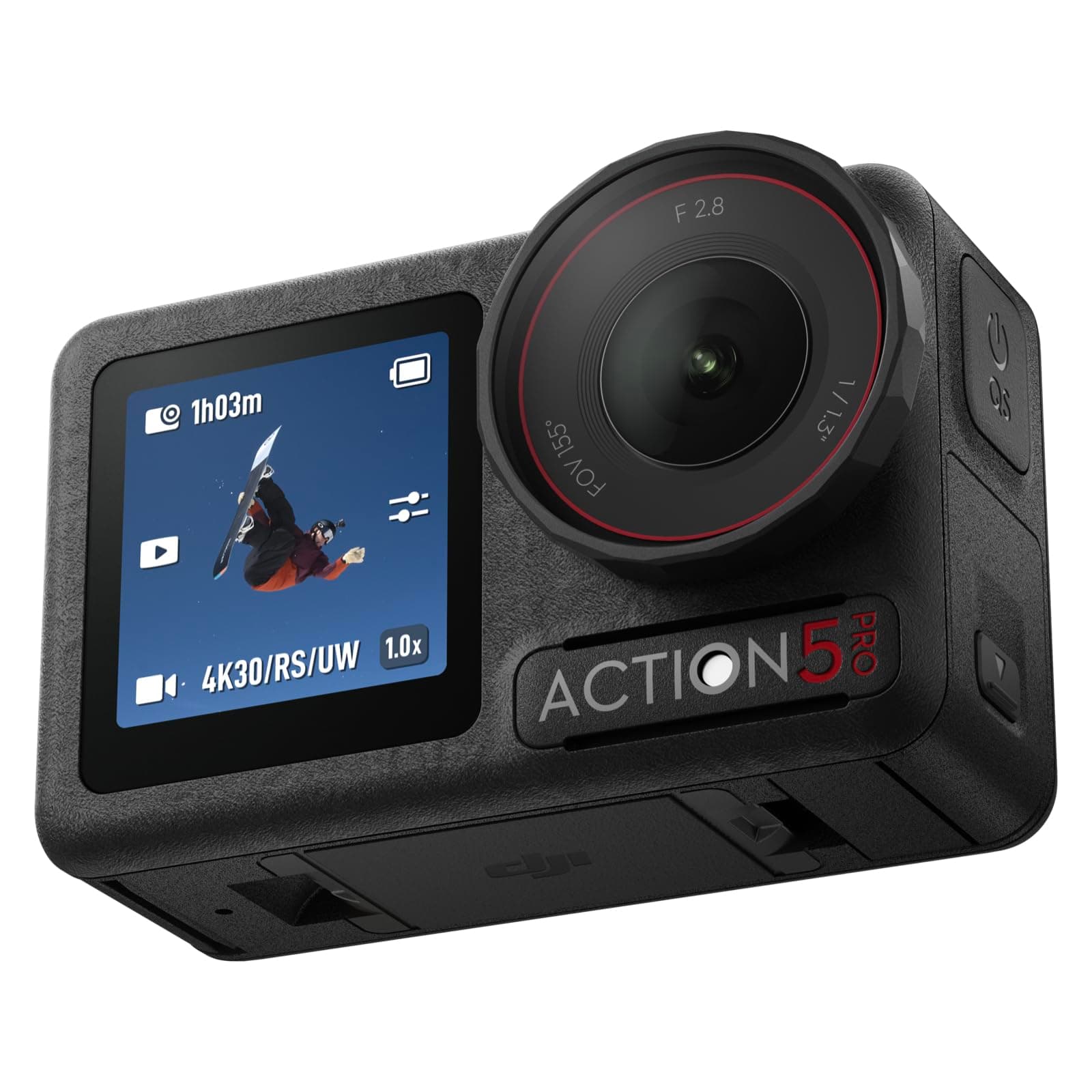
If you want a traditional action camera form factor that pulls no punches on imaging specs, battery efficiency, and audio ease of use, the DJI Osmo Action 5 Pro stands out as the standard to beat. DJI engineered this camera specifically to solve the historical weak points of action cameras: poor low-light performance, short battery life in extreme cold, and cumbersome external microphone setups.
Sensor Performance & Low-Light Dynamic Range
The core of the Osmo Action 5 Pro is its all-new 1/1.3-inch sensor featuring large 2.4 µm pixels and an impressive 13.5 stops of dynamic range. Action cameras traditionally struggle in dim lighting or high-contrast scenarios—such as riding through dense forests with breaking sunlight—resulting in muddy shadows and blown-out highlights. According to published specifications, the Action 5 Pro uses an advanced 4nm processing chip alongside a dedicated color temperature sensor to automatically adjust white balance and maintain natural color accuracy, even underwater or under streetlights.
For framing and control, the camera features dual ultra-bright OLED touchscreens on both the front and back. Unlike washed-out LCDs of older generations, these OLED panels remain sharp and readable under harsh direct sunlight, allowing quick setting tweaks whether you are holding the camera facing yourself or mounting it on handlebars.
Battery Life, Waterproofing, and Wireless Audio
Where the Osmo Action 5 Pro completely pulls ahead of its competitors is power management. The included high-capacity 1950mAh battery provides up to 4 hours of continuous recording under standard conditions, and can still achieve roughly 3.6 hours of operation in sub-zero freezing environments (-20° C / -4° F). That thermal performance makes it a standout choice for winter sports enthusiasts who are tired of batteries draining in twenty minutes on the chairlift.
The physical body is IP68 rated for direct submersion down to 20 meters (roughly 65 feet) without requiring an external waterproof housing. Stabilization is handled by 360° HorizonSteady, which completely neutralizes heavy roll-axis rotation up to full 360-degree flips while maintaining a perfectly level horizon.
Vloggers and content creators will also appreciate its direct wireless audio integration: the Osmo Action 5 Pro pairs natively with DJI Mic 2 and DJI Mic Mini transmitters without requiring an external receiver plug or cable dongle. You simply power on the transmitter and start recording pure, uncompressed audio directly into your video files.
Insta360 Ace Pro 2: The High-End AI Hybrid Alternative
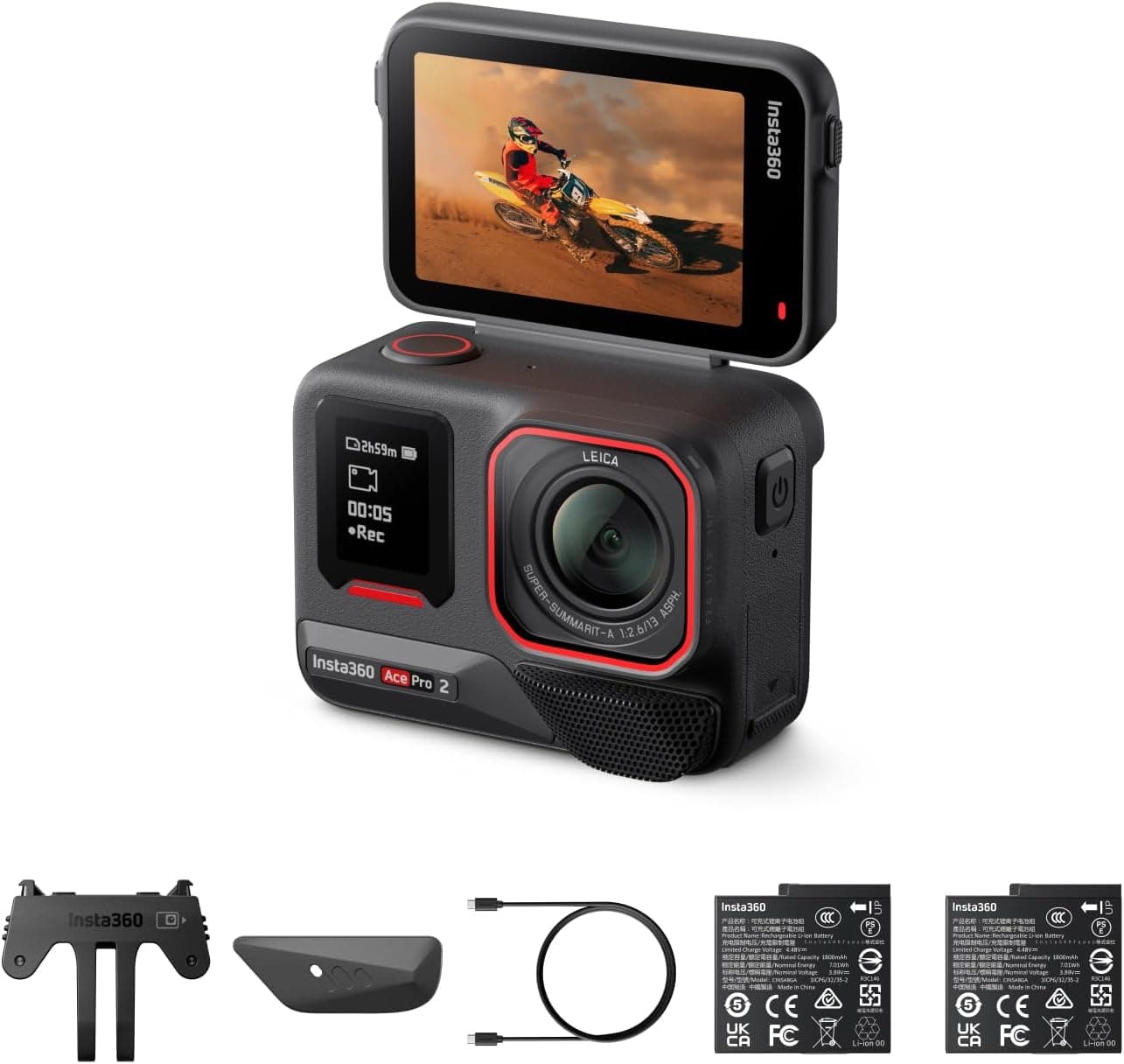
For creators looking for maximum resolution and computational video processing, the Insta360 Ace Pro 2 offers an intriguing alternative centered on Leica optics, AI noise reduction, and flip-screen versatility. Built around a large flip-up rear touchscreen display, it caters heavily to vloggers, street photographers, and travelers who want quick framing adjustments without guessing angles.
Battery Capabilities & Modular Ergonomics
The camera comes equipped with a 2010mAh battery capable of delivering extended recording times. When paired with modular accessories like the Xplorer Grip kit, total continuous recording in lower resolutions like 1080p24 can reach over 5.5 hours, or up to 140 minutes when shooting high-demand 4K60 with Active HDR enabled. The grip integration converts the compact camera body into an ergonomic street photography tool with physical exposure controls, mode toggles, and lossless digital zoom directly at your fingertips.
Where It Fits Best
The Ace Pro 2 shines brightest in mixed-use environments where pure action recording overlaps with daily travel vlogging. Its Active HDR processing retains highlight detail in bright skies, while firmware updates continuously optimize clarity across its digital lens profiles. However, its flip-up screen mechanism introduces a mechanical hinge that requires more careful handling than the fully fixed, sealed body of the DJI Osmo Action 5 Pro or the screenless armor of the GoPro Mini.
Head-to-Head Feature Comparison
1. Durability and Crash Resistance
When impact resistance is your number one priority, the GoPro HERO11 Black Mini takes the top spot purely because it has no large display glass to shatter upon landing. Its structural rigidity and flush rear mounting fingers make it ideal for drone top-mounts or bike helmets where impact is likely. On the flip side, the DJI Osmo Action 5 Pro provides rugged durability with a fully sealed body rated to 20m depth, but its dual glass OLED touchscreens mean you will want screen protectors if you operate in high-gravel environments.
2. Low-Light Performance and Image Quality
Action camera sensors are notoriously small, but DJI's 1/1.3-inch sensor with 2.4 µm pixels on the Action 5 Pro clearly outperforms smaller-pixel alternatives when dusk sets in. Combined with 13.5 stops of dynamic range, it captures nuanced shadow detail without excessive digital noise artifacts. While the GoPro HERO11 Mini's 5.3K video offers exceptional detail in bright daylight, its smaller effective pixel size shows grain earlier when shooting in low light.
3. Audio Workflows and Vlogging
If you plan to speak to the camera regularly, audio convenience becomes just as critical as video quality. The DJI Osmo Action 5 Pro's direct receiverless connection to DJI Mic 2 transmitters makes setting up a wireless lavalier mic completely effortless. The Insta360 Ace Pro 2 relies on its flip screen for self-framing visual checks, making both cameras far superior vlogging tools than the screenless GoPro Mini, which requires phone app streaming just to verify your angle.
Which Action Camera Should You Buy?
Choosing between these three distinct devices comes down to evaluating where you mount your camera and how long you need it to run without maintenance.
- Buy the DJI Osmo Action 5 Pro if: You want the best overall all-rounder on the market. Its 4-hour battery life, 20m native waterproofing, low-light dynamic range, and direct wireless mic pairing make it the most polished tool for vloggers, skiers, divers, and daily action shooters alike.
- Buy the GoPro HERO11 Black Mini if: You need an ultra-compact, aerodynamic camera exclusively for mounting to a helmet, chest harness, or FPV drone where extra screens add unnecessary weight and risk breaking.
- Buy the Insta360 Ace Pro 2 if: You want a flip-screen hybrid camera designed around modular grips, long endurance shooting modes, and computational AI HDR processing for travel and street photography.
Final Verdict
While screenless designs like the GoPro HERO11 Black Mini fill an important niche for high-impact sports where raw durability matters most, the DJI Osmo Action 5 Pro takes our top overall recommendation. By delivering class-leading 4-hour battery performance, phenomenal low-light range, direct mic connectivity, and ultra-bright dual OLED screens, DJI has engineered an action camera that handles virtually any scenario without frustrating compromises.