As an Amazon Associate I earn from qualifying purchases. This page contains affiliate links, and I may earn a commission at no extra cost to you.
The Red Light Therapy Dilemma: Sizing Up Your Options
Buying a red light therapy panel used to mean spending over a thousand dollars for sleek branding and heavy marketing hype. Thankfully, manufacturers like Hooga have shifted that landscape by offering robust, high-irradiance panels built with metal housings and modular components at far more sensible prices. But once you settle on a trusted brand, you face a practical fork in the road: how big of a panel do you actually need?
The choice between a medium-sized panel like the Hooga HG500 Red Light Therapy Panel and a full-body model like the Hooga HG1000 Red Light Therapy Panel comes down to treatment area, routine convenience, and your physical setup space. Both units share core wavelengths and heavy-duty iron construction, but their size differences change how you use them every day. Let's break down how these two popular panels stack up so you can invest in the right setup for your space and habits.
Core Science & Shared Hardware
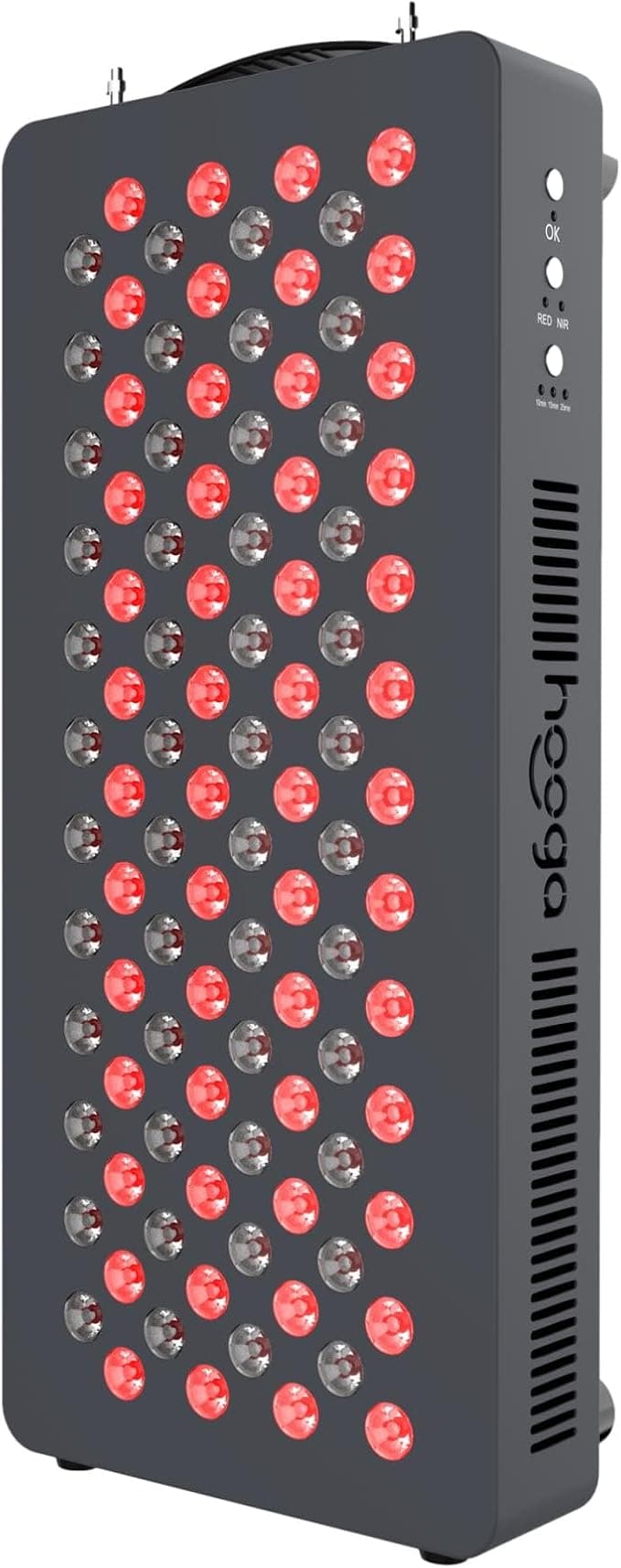
Before looking at size differences, it helps to understand what both panels deliver at a hardware level. Both the HG500 and HG1000 utilize a 1:1 mix of two clinically studied light wavelengths: 660 nanometers (red light) and 850 nanometers (near-infrared light).
- 660nm Red Light: Absorbed primarily by surface tissue and skin, making it popular for skin care routines, superficial tissue recovery, and collagen support.
- 850nm Near-Infrared (NIR) Light: Invisible to the naked eye, NIR light penetrates deeper into muscle tissue, joints, and underlying structures for post-workout wind-downs and general deep-tissue care.
Both panels house their high-output LEDs inside rigid iron chassis built for long-term durability. Because intense LED arrays generate ambient heat that can degrade diode performance over time, both models incorporate internal active cooling fans. According to manufacturer specifications, these LEDs carry a 50,000+ hour lifespan and are backed by a 3-year warranty with U.S.-based customer support.
Hooga HG500: The Targeted Workhorse
The Hooga HG500 Red Light Therapy Panel features 100 dual-chip LEDs packed into a compact iron enclosure. It is designed specifically for targeted wellness routines—ideal if your primary goal is facial skin care, upper back treatment, or treating individual joints like knees or shoulders.
Build & Mounting Setup
Unlike small desktop light devices, the HG500 provides substantial physical coverage without occupying a massive footprint on your wall or door. It includes an overhead door hook and pulley hanging kit. It is important to note that the HG500 does not include a built-in tabletop stand; you will need to hang it over a door or mount it securely to a wall fixture to use it comfortably.
Who the HG500 Suits Best
If you plan to use red light therapy focused on specific muscle groups or your face and neck, paying for a giant 200-LED panel is overkill. The HG500 delivers identical light intensity per square inch as its larger sibling, making it the smarter, lower-cost option for localized routines.
Hooga HG1000: Full-Body Coverage & Extra Control
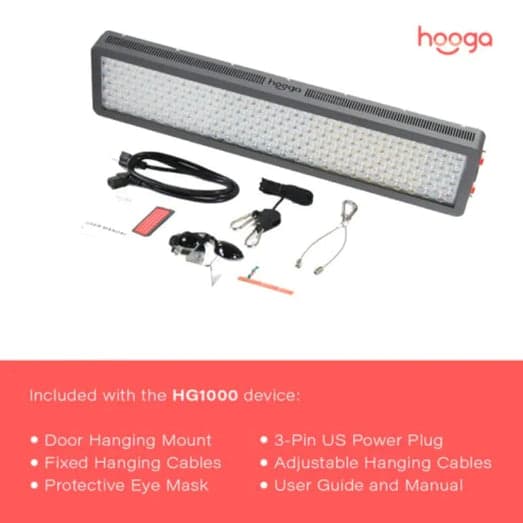
The Hooga HG1000 Red Light Therapy Panel doubles the light output with 200 dual-chip LEDs. At roughly double the physical length of the HG500, it expands your treatment zone from a localized spot to a wide swathe of your torso, legs, or entire back in a single session.
Key Feature Upgrade: Integrated Digital Timer
Beyond physical dimensions, the most notable feature difference on the HG1000 is its built-in digital timer. While the HG500 relies on simple physical power toggles—requiring you to set an alarm on your phone or use a wall timer—the HG1000 lets you program your session duration directly on the panel. When your 10 or 15 minutes are up, the light shuts off automatically.
Mounting & Placement Considerations
Because the HG1000 is significantly heavier and taller than the HG500, hanging setup requires a sturdy door or mounting point. The included hanging kit handles the weight safely, but you need dedicated vertical clearance. If you plan to move your panel between rooms frequently, the HG1000's bulk requires more effort than the nimbler HG500.
Head-to-Head Feature Comparison
| Feature / Spec | Hooga HG500 | Hooga HG1000 |
|---|---|---|
| LED Count | 100 LEDs | 200 LEDs |
| Wavelengths | 660nm Red / 850nm NIR | 660nm Red / 850nm NIR |
| Built-In Timer | No (Manual Switches) | Yes (Digital Auto-Off) |
| Housing Material | Iron Chassis | Iron Chassis |
| Cooling System | Active Cooling Fans | Active Cooling Fans |
| Included Accessories | Door Hanging Kit | Door Hanging Kit |
| Target Area | Targeted (Face, Back, Joints) | Broad / Full Body |
| Price Band | Mid-Range ($150–$200 class) | Upper Mid-Range ($300–$400 class) |
| Direct Link | View HG500 on Amazon | View HG1000 on Amazon |
Real-World Usability & Practical Trade-Offs
Choosing between these two panels isn't just a matter of budget—it dictates how easily you will maintain your daily wellness habit.
Session Efficiency
If you want full-body coverage with the HG500, you will have to divide your session into multiple steps: lower body first, upper body second, turn around, and repeat. That 10-minute session quickly turns into 30 minutes. The Hooga HG1000 Red Light Therapy Panel cuts total session time down dramatically because its wide beam covers your entire torso and thighs at once.
Noise & Power Output
Because both panels rely on high-output LEDs, internal cooling fans are mandatory. Reviewers and owners commonly note that while fan noise is noticeable (similar to a quiet computer desktop tower), it isn't distracting. However, the HG1000 features more internal fans to cool its 200 diodes, producing slightly more ambient airflow noise during operation.
Lack of Tabletop Stands
A common complaint among buyers in this category is setup expectation. Neither the HG500 nor the HG1000 comes with a desktop kickstand. If you expect to set your panel on a nightstand without mounting it, you'll need to lean it carefully against a wall or buy a separate floor stand. Plan on using the included door pulley system for the most secure and adjustable experience.
Which One Should You Buy?
Both panels offer exceptional value compared to high-end spa panels costing thousands of dollars, but your intended routine should dictate your pick.
Buy the Hooga HG500 if:
- You want focused treatments for your face, neck, knees, or specific muscle groups.
- You have limited door space or want a lighter panel that is easier to store when not in use.
- You prefer to keep your initial investment low while getting genuine high-irradiance hardware.
Buy the Hooga HG1000 if:
- You want to cover your entire back, chest, or legs in a single session without moving the light around.
- You value the integrated auto-off timer so you can relax without staring at a smartphone clock.
- You have a dedicated home gym, bedroom door, or wellness room where the larger panel can stay mounted permanently.
Final Verdict
For most people building a comprehensive at-home light therapy routine, the Hooga HG1000 Red Light Therapy Panel is worth the extra investment. The double LED count saves precious time during daily sessions, and the built-in timer adds everyday convenience. However, if space is tight or your physical focus is strictly targeted, the Hooga HG500 Red Light Therapy Panel delivers identical red and near-infrared light performance in a compact, budget-friendly package.