Search for a budget coding robot and most of what comes back is the same idea wearing different boxes: unbranded imports with “STEM” printed hopefully on the front, a toy that waddles off in a vague circle at the press of one button, and no learning design behind any of it. That’s remote control, not programming — a child presses and watches, but never plans anything.
The three here are the other kind. They’re all Learning Resources toys — the company has spent forty years building educational kit for classrooms — and all three are screen-free, so the coding happens with buttons, cards, tiles and printed stories rather than an app. No borrowing your phone, nothing to install, and it all works out of the box on the living-room floor, which is exactly what you want from a birthday or Christmas present. They’re also sorted by the coding idea each one teaches, from first sequencing up to loops and simple “if this, then that” logic. One of the three sits a few pounds past the £50 line rather than under it, and I’ll say so plainly when we get there rather than waving it through.
As an Amazon Associate I earn from qualifying purchases. This page contains affiliate links, and I may earn a commission at no extra cost to you.
What a cheap coding robot should actually do
“Coding toy” does a lot of heavy lifting on gift lists. The floor for anything wearing that label is sequencing: a child plans a series of commands, sets it going, and learns from what actually happens versus what they expected. Plan, run, adjust, repeat — that loop is what separates a coding toy from a remote-controlled novelty, however many lights the novelty has.
Above sequencing sit the ideas worth paying extra for: loops, where a chunk of commands runs again and again instead of being retyped, and simple conditional logic — “if that happens, do this”. Most budget coding toys stop at sequencing, which is perfect for a four-year-old and a dead end for a seven-year-old. Match the toy to the child’s stage, not the birthday candle count, and you’ll choose well.
The three at a glance
Quick side-by-side, with the practical details and a route to each one:
| Robot | What it teaches | Price | Verdict | Buy |
|---|---|---|---|---|
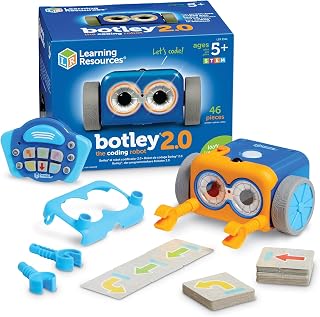
| Learning Resources Botley 2.0 Activity Set | Sequences up to 150 steps, loops, simple if/then logic, 16 transformations | Just over £50 | The stretch worth making | Check today's price on Amazon |
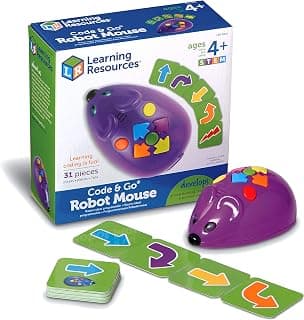
| Learning Resources Code & Go Robot Mouse Activity Set | First sequencing with 30 coding cards, ages 4+ | Around £35 | Friendliest first step | Check today's price on Amazon |
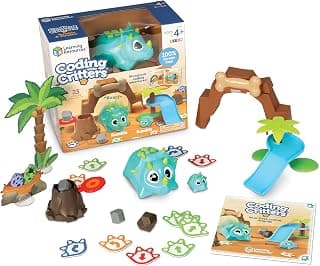
| Learning Resources Coding Critters Rumble & Bumble | Storybook coding challenges, pet pretend play, ages 4+ | Under £50 | Best blend of coding and play | Check today's price on Amazon |
Learning Resources Botley 2.0: the stretch worth making
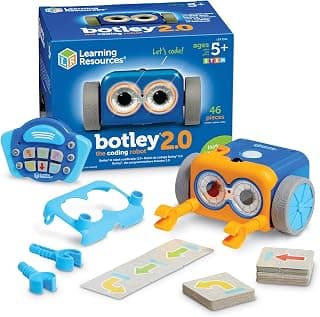
This is the next generation of Learning Resources’ award-winning Botley, built for coders from age five and built to keep them. Programming is entirely screen-free: commands are chained into sequences up to 150 steps deep on the remote programmer that comes in the box. A first-timer sends it three moves forward and whoops; a confident seven-year-old assembles an obstacle run detour by detour and still isn’t near the limit. Not many gift toys work across a mixed-age household like that.
The 16 interactions are the gift-day magic. Botley can transform into a train, a police car, a ghost and more, with music, lights and movement woven into the expanded coding styles. Those surprises are why this one survives the first weekend — there’s discovery layered underneath the learning, and a child who finds one transformation immediately hunts for the next.
It’s also the only pick here that takes a child past sequencing. Botley 2.0 handles loops — repeat this block rather than retype it — and simple if/then logic, where a programme isn’t just a route but a set of rules the robot acts on. Those are the building blocks of every real programming language, and at a budget price they’re genuinely rare. The same route can finish in a tune, a light show or a little routine rather than just an arrival, which keeps every success worth chasing.
An honest note on money: this one costs more than the other two, and if you can absorb it, the difference buys years of play rather than months. It’s often cheaper around Black Friday, so if the gift date gives you room to wait, that’s the week to buy.
It suits a five-to-eight-year-old with an itch to make things obey, and it’s the natural upgrade for a child who has already enjoyed a simpler sequencing toy. Skip it for under-fives — the two picks below are friendlier at that age — and for a child whose main wish is something to cuddle.
Learning Resources Code & Go Robot Mouse: the friendliest first step
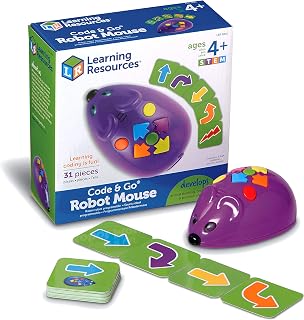
Made for ages four and up, and it shows in how fast a small child gets it. The routine: lay a route out with the 30 coding cards — right, right, forward, forward — punch that plan into the robot mouse with push-button controls, and send it on its way. Lights, sounds and two speeds keep things lively on every run.
The cards are the cleverest part, more than the mouse itself. Writing the plan down first, testing it, then swapping two cards when it goes wrong teaches debugging in physical form — the core habit of every programmer — before a screen has ever entered the picture. As a syllabus it targets sequencing, logic, problem solving and directional thinking, which is exactly right for a first coding toy. In practice this is a kitchen-floor toy: two children can take turns planning routes, and the gentle speed setting buys a younger sibling time to watch before their go.
The ceiling is low, in a friendly way. There’s no looping or rule-making here — just ordered steps — and with 30 cards the plans stay compact. A four-to-six-year-old is the sweet spot; a confident seven-year-old already stacking commands will finish with this inside a year and is better served by Botley. It runs on three AAA batteries that aren’t included, so have them in the drawer before the unwrap.
Value is simple: this is the cheapest way into a genuinely good coding lesson by a wide margin, and the purest. It’s the pick for a fourth birthday, or for anyone who wants the lesson without the frills.
Learning Resources Coding Critters Rumble & Bumble: coding in disguise
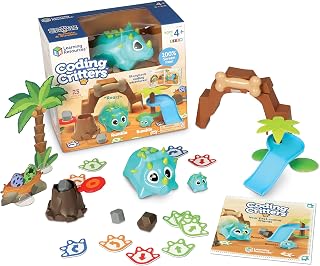
Two pet pals — Rumble, a bouncy bulldog, and Bumble the cat — with a 23-piece pet playset: a slide, a boulder, a cave and decorations, plus a full-colour storybook and 10 coding paw prints. The coding runs through the storybook: children take on coding challenges page by page, laying paw-print trails and using simple press-button moves to send the pets along them, so the sequencing lesson arrives inside a game of imaginative pet play rather than a robotics lecture.
Then there’s Play Mode, which turns the critters into pets rather than robots: children feed them, pet them and take care of them, and the pets respond. For a child whose ideal animal is a puppy, this is the coding toy that doesn’t announce itself as one — and it plays beautifully as a shared toy, one child laying the trail while the other runs the pet.
Trade-offs, plainly: the programming is the gentlest of the three. Ordered steps, storybook scaffolding, pretend play — no loops, no logic, and the lowest ceiling here. A parent who wants to watch skills visibly ratchet up will lean towards Botley. Another three AAA batteries, again not included.
Which one for which child
- Fourth birthday or nursery age: the Robot Mouse — built from four, quickest to grasp, purest first lesson in sequencing.
- Five and up, mechanically minded: Botley 2.0 — the only one that grows into loops and if/then rules rather than being outgrown.
- Young and animal-mad: the Critters — a coding toy that gets played with because it behaves like a pet.
If Botley’s price is the sticking point
Holding the budget firm is sensible, not stingy — the Learning Resources Code & Go Robot Mouse Activity Set is a proper coding toy, not a consolation. It teaches the one concept everything else builds on, it’s kinder to the youngest hands, and the card-planning habit transfers straight to Botley if you upgrade next year. If the child leans animals-and-stories rather than robots-and-routes, the Critters set is the other door out.
Quick answers
Are all of these really screen-free?
Yes, completely. Botley is programmed with a remote programmer, the Robot Mouse with push buttons and coding cards, and the Critters with buttons plus the paw-print trails. No tablet, phone or app is needed at any point.
What age suits each one?
The Robot Mouse and Coding Critters are built from age four. Botley introduces coding from five, and its bigger ideas — loops and if/then logic — are the ones that keep a six or seven-year-old hooked. Under-fours will enjoy pushing buttons, but the planning part won’t click yet.
Is anything else needed in the box?
Batteries. The Robot Mouse and the Coding Critters each run on AAA batteries that aren’t included, so buy a pack before gift day. Everything else is there — coding cards for the mouse, and the storybook, paw prints, slide, boulder and cave playset pieces for the Critters.
Is Botley 2.0 worth it over the cheaper mouse?
If the child is five or older and likely to stick with it, yes. Sequences up to 150 steps, looping logic and the 16 transformations give it far more headroom than a toy that runs one planned route. If the budget is rigid or the child is only four, the Mouse teaches the same first lesson — sequencing — more gently.
Who should skip these entirely?
A child who wants speed and spectacle — a drone, a fast RC car — will find a coding robot slow going, because these reward patient, puzzle-minded play. And if a family wants screen-led coding lessons, these are deliberately the opposite of that.
The bottom line
The Learning Resources Botley 2.0 Activity Set is the one to buy: it’s the only pick here that takes a child from stacking three commands to loops and simple if/then logic, without a screen anywhere, and the 16 transformations are why it’ll still be out of the toy box long after the wrapping paper’s recycled. If the budget won’t bend, the Robot Mouse is a real first coding lesson rather than a make-do. If the child is four and animal-mad, start with the Critters.