As an Amazon Associate I earn from qualifying purchases. This page contains affiliate links, and I may earn a commission at no extra cost to you.
The Reality of Charging Laptops on the Move
Modern laptops have never been more power-hungry or more capable. While an ultra-efficient MacBook Air can sip power for over ten hours, firing up intensive rendering tasks, video calls, or running a 16-inch workstation laptop drains cells at an alarming rate. Finding a functioning mains socket on a delayed train or in a crowded airport lounge is rarely guaranteed. That is where a high-output, airline-approved portable power bank becomes essential gear rather than an optional accessory.
Selecting the right laptop power bank comes down to three non-negotiable metrics: continuous wattage output, total capacity measured against aviation limits, and how intelligent the internal power distribution is when multiple gadgets are plugged in. A charger claiming 100W across three ports might only deliver 45W to your laptop the moment your phone is plugged into the secondary port—leaving your computer slowly discharging despite being connected.
This buying guide examines four standout portable chargers across distinct wattage tiers and budgets. Each model has been analysed based on published manufacturer specifications, verified user reports, and circuit distribution profiles to help you choose the right power pack for your mobile setup.
Quick Comparison: Top Laptop Power Banks
| Power Bank | Capacity | Max Single Port Output | Total Max Output | Best Suited For | Check Price |
|---|---|---|---|---|---|
| INIU 140W 27,000mAh Power Bank | 27,000mAh (99.9Wh) | 140W (USB-C PD 3.1) | 140W | 16" Laptops, MacBooks & Heavy Creators | Check today's price on Amazon |
| UGREEN Nexode 130W 20,000mAh Power Bank | 20,000mAh (74Wh) | 100W (USB-C PD 3.0) | 130W | Commuters Wanting Real-Time Power Telemetry | Check today's price on Amazon |
| INIU 65W 20,000mAh Fast Charging Power Bank | 20,000mAh (74Wh) | 65W (USB-C PD) | 65W | Ultrabooks, Steam Deck & Budget Travel | Check today's price on Amazon |
| Belkin BoostCharge Pro 65W 20,000mAh Power Bank | 20,000mAh (74Wh) | 65W (USB-C PD 3.0 PPS) | 65W | Reliability Seekers & Enterprise Travel | Check today's price on Amazon |
1. INIU 140W 27,000mAh Power Bank – The High-Power Champion
For power users carrying high-draw machines like the 16-inch MacBook Pro, high-spec Dell XPS, or mobile gaming rigs, standard 65W power banks often merely slow down battery drain rather than rapidly charging the cell. The INIU 140W 27,000mAh Power Bank addresses this bottleneck by deploying full Power Delivery 3.1 (PD 3.1) protocol support.
Charging Capabilities and Port Configuration
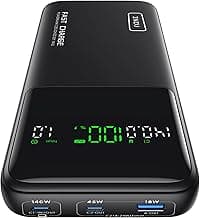
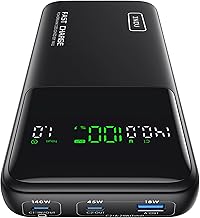
Equipped with a primary USB-C port capable of 140W bi-directional throughput, this unit matches the maximum charging rate that flagship laptops can accept over USB-C. In practical terms, manufacturer data indicates it can push a 16-inch MacBook Pro to roughly 59% in just 30 minutes, or an iPhone 15 Pro Max to around 71% in the same timeframe.
The unit features three ports: a primary 140W PD 3.1 USB-C port, a secondary 45W PD fast-charging USB-C port, and a standard USB-A port for legacy accessories. When multiple devices are connected, the smart power controller ensures the primary laptop port retains priority output rather than dropping down to trickle speeds.
Capacity and Aviation Compliance
The 27,000mAh capacity sits directly at the 99.9Wh ceiling mandated by international aviation guidelines (ICAO/FAA/CAA), which restrict lithium-ion batteries over 100Wh from carry-on luggage without prior airline approval. This makes it the largest capacity you can legally board a flight with without paperwork. It holds enough stored energy to recharge a 13-inch MacBook Air nearly twice or keep a handheld gaming console running across a long-haul flight.
Pros and Cons
- Pros: Massive 140W single-port PD 3.1 output; true 99.9Wh maximum legal flight capacity; charges the power bank itself back up in well under two hours with an appropriate wall charger; lifetime technical support backing.
- Cons: Noticeably heavy in a compact sling bag; requires a 100W+ capable wall plug to experience fast recharge times.
2. UGREEN Nexode 130W 20,000mAh Power Bank – The Smart Telemetry Specialist
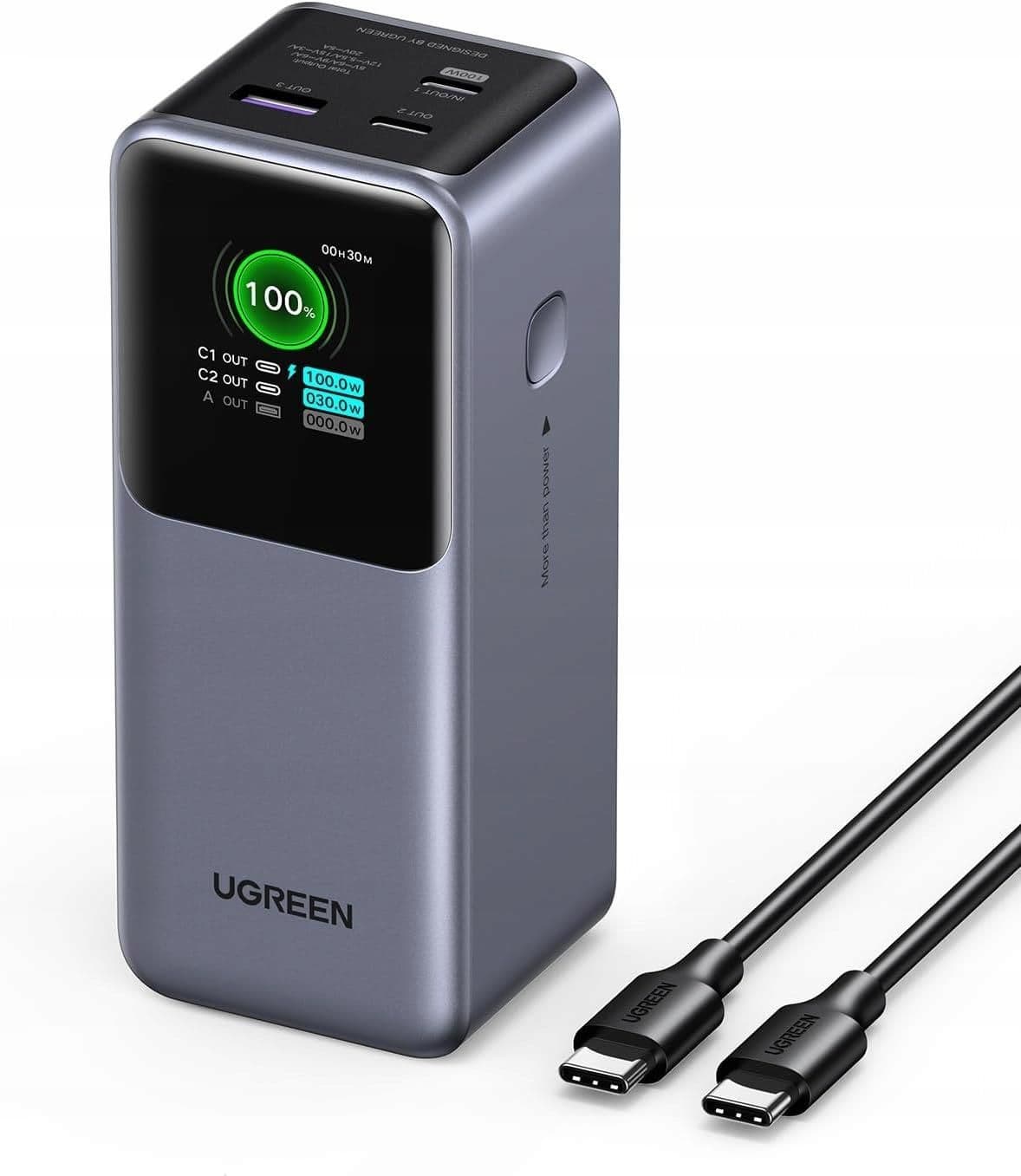
If you value knowing exactly what is happening beneath the casing, the UGREEN Nexode 130W 20,000mAh Power Bank stands out due to its column design and integrated colour TFT screen.
Form Factor and Real-Time Display
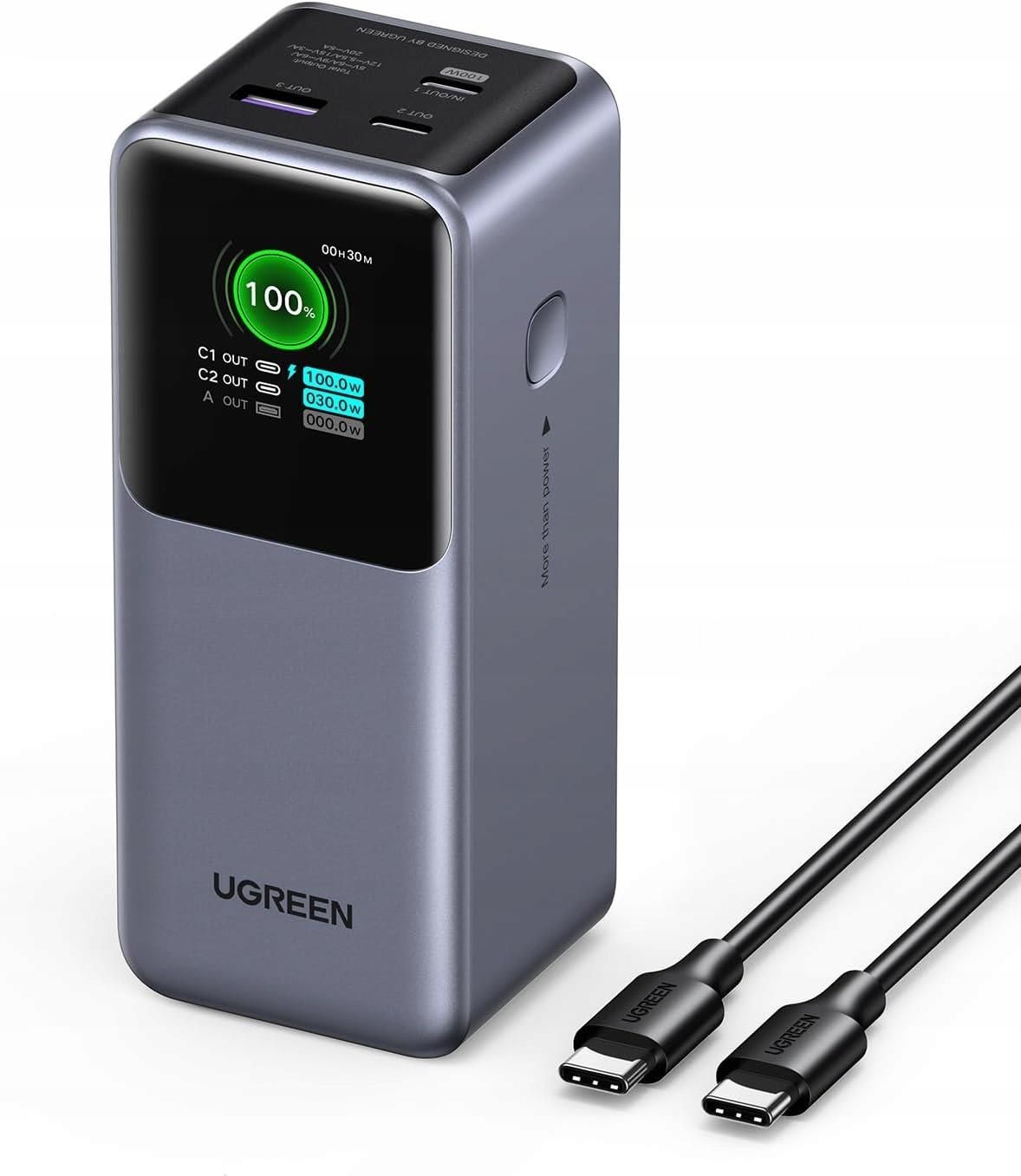
Rather than relying on vague four-dot LED indicator lights, UGREEN integrates an advanced digital TFT display. This screen provides precise real-time diagnostics: battery percentage, current voltage, amperage, and exact wattages distributed across each active port. If your cable is faulty or your laptop has throttled its intake due to heat, the screen immediately confirms the drop in wattage.
The physical footprint utilizes a pillar shape measuring approximately 5.1 × 2.1 × 2 inches and weighing around 480g. This space-saving design slips comfortably into the water bottle pocket of a backpack or upright inside a briefcase compartment.
Power Distribution and Compatibility
The Nexode delivers up to 100W from its primary USB-C port, sufficient to charge a 13-inch MacBook Air 1.3 times or an iPad Pro 11-inch twice. Combined across its dual USB-C and single USB-A ports, it pushes a total combined output of 130W (e.g. 100W laptop + 30W phone). It covers all critical charging handshakes: PD 3.0, PPS (Programmable Power Supply for Samsung Fast Charging 2.0), Quick Charge, SCP, and AFC.
Pros and Cons
- Pros: Crisp TFT display eliminates charging guesswork; compact column footprint is easy to pack; wide protocol support including PPS.
- Cons: 20,000mAh provides slightly less total runtime reserve than 27,000mAh alternatives; single-port output maxes out at 100W rather than 140W.
3. INIU 65W 20,000mAh Fast Charging Power Bank – The Lightweight Everyday Option
High-wattage bricks are fantastic for power users, but they add bulk. For users carrying an everyday ultrabook, iPad Pro, or Steam Deck, the INIU 65W 20,000mAh Fast Charging Power Bank strikes an exceptional balance between physical volume and real charging capability.
Compact Engineering and Integrated Cable
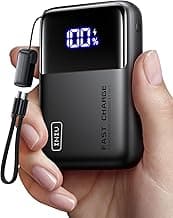
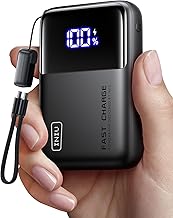
By using high-density battery cell stacking, INIU reduced the overall volume of this 20,000mAh pack by approximately 38% compared to standard traditional bricks, bringing the footprint down close to a thick wallet. A thoughtful design touch is the detachable 12cm braided nylon USB-C lanyard cable. It functions as a carry handle while attached, ensuring you never find yourself stuck with a full battery pack and no connecting lead.
Practical Output for 65W Ultrabooks
A single 65W USB-C output provides plenty of juice for thin-and-light machines like the Dell XPS 13, MacBook Air, Asus Zenbook, and Lenovo ThinkPads. In tests against published specs, it replenishes typical ultrabooks to 50% capacity in around 30 minutes without triggering low-power warnings. It also powers the Steam Deck and Asus ROG Ally at full operational speed whilst playing.
Pros and Cons
- Pros: Remarkably compact footprint for a 20,000mAh cell; detachable lanyard cable ensures you always have a lead; 3-year replacement warranty; very competitive mid-tier pricing.
- Cons: 65W maximum output will limit charging speeds on 15" and 16" performance laptops; dual-device charging drops primary port wattage.
4. Belkin BoostCharge Pro 65W 20,000mAh Power Bank – The Enterprise-Grade Performer
Belkin has long maintained a reputation for manufacturing rock-solid charging hardware that strictly adheres to USB-IF safety standards. The Belkin BoostCharge Pro 65W 20,000mAh Power Bank is engineered specifically for corporate travellers and reliability-first users.
GaN Efficiency and Thermal Performance
Using integrated Gallium Nitride (GaN) semiconductor technology, the BoostCharge Pro manages thermal dissipation far better than older silicon-based banks. Even when sustaining prolonged 65W output to a depleted laptop, surface temperatures remain controlled, reducing thermal throttling and protecting the lifespan of both the power bank and connected hardware.
Dynamic Power Allocation
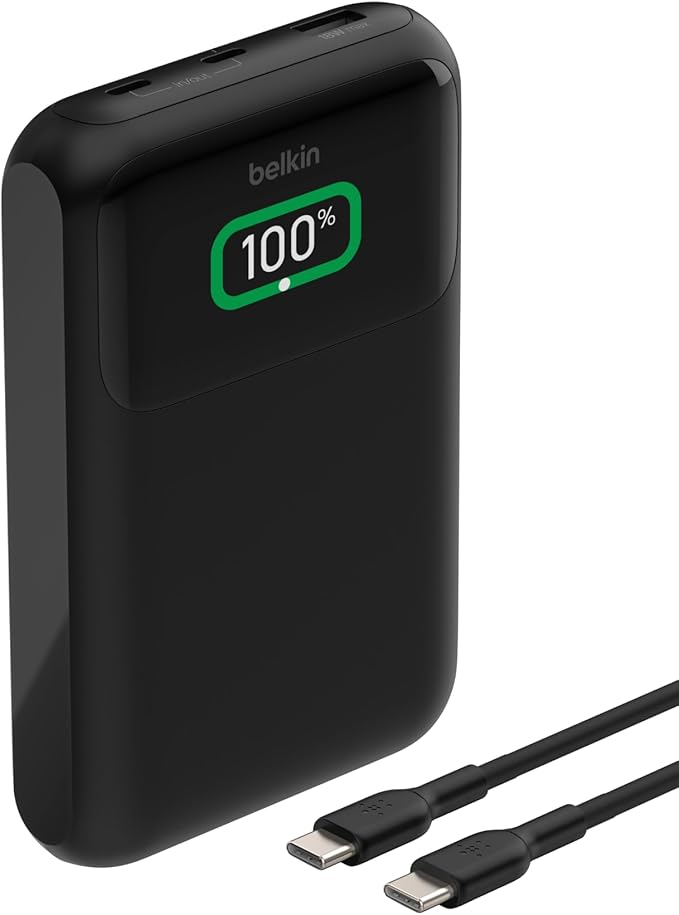
The charger features two dedicated USB-C ports. When powering a solitary device, the lead port delivers the full 65W. When plugging in a laptop alongside a smartphone, the internal GaN chipset automatically divides the stream into an optimised 45W + 20W split. This provides enough continuous wattage to keep an ultrabook running while concurrently fast-charging an iPhone or Samsung Galaxy via PPS technology.
Pros and Cons
- Pros: Premium GaN design ensures cooler, safer charging cycles; clean 45W + 20W dual-port power distribution; robust build quality backed by extensive safety certification.
- Cons: Higher price tier relative to raw wattage output; lacks a legacy USB-A port for older peripherals.
Buying Guide: What to Look for in a Laptop Power Bank
1. Output Wattage vs Laptop Ingestion Rates
Laptops are significantly more demanding than phones. An ultraportable machine typically requires at least 45W to 65W over USB-C Power Delivery to charge whilst in use. Workstation laptops and 16-inch MacBooks often demand 100W to 140W to charge under heavy CPU/GPU loads. If you plug a 30W phone charger into a high-end laptop, the system may display a "Plugged in, not charging" warning or slowly discharge.
2. The Airline 100Wh Rule
Aviation security standards (ICAO and UK CAA) state that passenger power banks carried in cabin baggage must not exceed 100 Watt-hours (Wh). To calculate Wh from milliamp-hours (mAh):
(mAh × 3.7V nominal) ÷ 1,000 = Watt-hours
A 20,000mAh bank equates to roughly 74Wh, while a 27,000mAh bank comes out to approximately 99.9Wh. Any battery exceeding 27,000mAh generally requires airline approval and cannot be placed in checked luggage under any circumstances.
3. Port Splitting Mechanics
Always inspect the multi-port power allocation chart in the specifications. When a manufacturer advertises "130W Total Output", that is typically a combined figure (such as 100W from Port 1 + 30W from Port 2). If you need to run two high-draw machines simultaneously, ensure the primary port maintains at least 45W to 65W when secondary ports are occupied.
Alternatives to Consider
If your charging needs sit outside the four primary recommendations above, consider these alternative setups:
- For Budget Ultrabook Users: If you only need occasional emergency top-ups for a thin-and-light laptop and prefer the lowest weight possible, stick with a 65W 20,000mAh unit like the Check today's price on Amazon, which offers great value per watt.
- For Maximum Multi-Device Workstations: If you routinely carry a 16-inch laptop, a tablet, and a phone that all need rapid power at once, step up to the Check today's price on Amazon for its uncompromised 140W single-port ceiling.
Summary and Final Recommendation
If you need maximum output, zero charging compromises, and the highest legally permissible flight capacity, the INIU 140W 27,000mAh Power Bank is the clear overall winner. Its PD 3.1 140W output easily handles workstation laptops, making it the most future-proof pick on the market.
For commuters who prefer a compact column shape with real-time screen telemetry, the UGREEN Nexode 130W is a fantastic daily companion. Meanwhile, ultrabook users seeking the best blend of portability, affordability, and utility will find the wallet-sized INIU 65W Power Bank tough to beat.