As an Amazon Associate I earn from qualifying purchases. This page contains affiliate links, and I may earn a commission at no extra cost to you.
The Wi-Fi 7 Reality Check: Speed, Spectrum, and Real Value
Upgrading home broadband hardware rarely feels urgent until high-bandwidth demands expose the weak points in your setup. If you have recently upgraded to multi-gigabit fibre broadband, work with local network-attached storage (NAS), or juggle dozens of smart home devices alongside 4K streams and competitive online gaming, standard ISP-supplied routers quickly run out of steam. Wi-Fi 7 (802.11be) introduces massive technical leaps: wider 320 MHz channels, 4K-QAM modulation, and Multi-Link Operation (MLO), which allows devices to transmit data across multiple radio frequency bands at the exact same time.
However, moving to a next-generation mesh system involves a substantial financial commitment. Investing hundreds—or even thousands—of pounds makes sense only if the hardware delivers practical benefits in your physical space. In this comprehensive buying guide, we break down the leading mesh networking platforms to help you determine which system matches your home footprint, wiring infrastructure, and daily bandwidth requirements.
Quick Comparison Table
Here is how the top Wi-Fi 7 mesh solutions compare across core technical specifications, port configurations, and price bands:
| Product | Wireless Standard | Peak Bandwidth | Wired Multi-Gig Ports | Price Band | Buy |
|---|---|---|---|---|---|
| TP-Link Deco BE85 | Tri-Band Wi-Fi 7 | Up to 22 Gbps | 2× 10 Gbps + 2× 2.5 Gbps | Premium | Check today's price on Amazon |
| Amazon eero Max 7 | Tri-Band Wi-Fi 7 | Up to 9.4 Gbps | 2× 10 Gbps + 2× 2.5 Gbps | Premium | Check today's price on Amazon |
| NETGEAR Orbi 970 Series | Quad-Band Wi-Fi 7 | Up to 27 Gbps | 1× 10 Gbps + 4× 2.5 Gbps (per node) | Ultra-Premium | Check today's price on Amazon |
| D-Link AQUILA PRO AI M30 | Dual-Band Wi-Fi 6 (Value Option) | Up to 3,000 Mbps | 1× 1 Gbps WAN + 4× Gigabit LAN | Budget | Check today's price on Amazon |
1. TP-Link Deco BE85: The Versatile Port Powerhouse
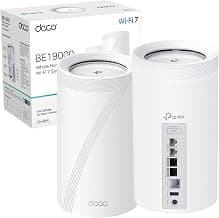
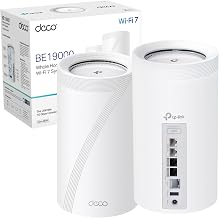
The TP-Link Deco BE85 Tri-Band Whole Home Mesh Wi-Fi 7 System represents one of the most thoroughly engineered Wi-Fi 7 mesh packages currently on the market. Delivering an aggregate wireless bandwidth of up to 22 Gbps across 12 simultaneous streams, it pairs a massive 11,520 Mbps allocation on the clean 6 GHz band with 5,760 Mbps on 5 GHz and 1,376 Mbps on 2.4 GHz. It fully supports 320 MHz channel widths and MLO, making it ideal for modern Wi-Fi 7 client devices like the latest smartphones and high-end laptops.
Where the Deco BE85 genuinely pulls ahead of rival systems is its exceptional physical port array. Each individual node features one 10 Gbps Ethernet/SFP+ combo port, one dedicated 10 Gbps RJ45 Ethernet port, and two 2.5 Gbps ports, alongside a USB 3.0 port for basic local storage sharing. This gives power users enormous flexibility: you can establish a true 10 Gbps wired backhaul between nodes while still having high-bandwidth wired ports available for gaming rigs, switches, or high-speed NAS enclosures.
Software and Management
Management is handled through the TP-Link Deco mobile app, which streamlines the setup process and network monitoring. TP-Link bundles its HomeShield security suite, providing automated IoT device isolation, basic parental controls, and malicious site blocking. Advanced security analytics and granular parental filtering require an optional subscription, but standard network settings—such as guest networks and basic QoS prioritisation—remain free to configure.
Who It's For
Homes equipped with 1 Gbps to 10 Gbps full-fibre broadband connections, multi-gig wired backhaul cabling, and users who demand extensive high-speed Ethernet ports directly on each mesh satellite node.
Who Should Skip
Buyers looking for ultra-compact hardware (the cylindrical nodes are relatively tall and heavy) or those who do not require multi-gigabit wired infrastructure.
2. Amazon eero Max 7: Streamlined Smart Home Synergy
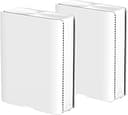
The Amazon eero Max 7 Tri-Band Mesh Wi-Fi 7 Router takes a decidedly different approach by prioritising effortless deployment and deep smart-home integration. Each compact node covers up to 230 m² (roughly an 8.5-metre radius) and supports over 250 connected devices. Featuring two 10 Gbps Ethernet ports and two 2.5 Gbps ports, it easily accommodates multi-gigabit broadband tiers and high-speed backhauls.
Eero relies on its proprietary TrueMesh technology, which dynamically routes data across the least congested wireless paths. Where the eero Max 7 shines most is as an integrated smart home controller. It includes built-in radios for Zigbee, Thread Border Routing, and Matter controller functionality, enabling you to manage smart lighting, sensors, and smart plugs without needing additional standalone hardware bridges.
Software Experience and Considerations
The eero app offers one of the slickest, most user-friendly setup flows available. However, power users should note that eero keeps advanced networking controls deliberately minimal: you will not find manual channel selection or complex split-SSID configurations. Furthermore, premium security tools, detailed historical bandwidth logging, and advanced ad-blocking are locked behind the optional eero Plus subscription service.
Who It's For
Busy households and smart home enthusiasts invested in the Alexa/Matter ecosystem who want high-performance Wi-Fi 7 speeds combined with completely automated background network management.
Who Should Skip
Network hobbyists who demand granular manual configuration settings, advanced local routing adjustments, or subscription-free access to extended bandwidth telemetry.
3. NETGEAR Orbi 970 Series: Uncompromising Quad-Band Reach
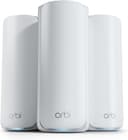
For palatial properties and demanding network layouts where running physical Ethernet cables between floors is impossible, the NETGEAR Orbi 970 Series Quad-Band Mesh Wi-Fi 7 System sits at the pinnacle of wireless throughput. Unlike standard tri-band systems, the Orbi 970 incorporates an exclusive quad-band architecture that dedicates a full high-speed wireless channel purely to satellite backhaul communication, ensuring connected devices never fight satellite traffic for wireless airtime.
Delivering up to 27 Gbps across its combined bands, a three-pack configuration covers up to 8,200 sq ft effortlessly. The primary router houses a 10 Gbps WAN port, one 10 Gbps LAN port, and four 2.5 Gbps LAN ports, with satellites matching similar multi-gigabit wired capabilities. In multi-storey houses with thick masonry walls, the dedicated quad-band backhaul maintains blisteringly fast throughput at long range.
Who It's For
Owners of very large properties with ultra-fast fibre connections who rely strictly on a wireless backhaul and want the absolute maximum wireless speeds across sprawling floor plans.
Who Should Skip
Budget-conscious buyers. The Orbi 970 carries a four-figure price tag that represents serious overkill for small-to-medium households or properties already wired with Ethernet.
4. Value Alternative: D-Link AQUILA PRO AI M30
Not every home network requires cutting-edge 10 Gbps hardware. If your broadband connection is 500 Mbps or below and you simply want to eliminate Wi-Fi dead spots without spending hundreds of pounds, the D-Link AQUILA PRO AI M30 AX3000 Smart Mesh System provides a practical, budget-conscious Wi-Fi 6 alternative.
The M30 features a distinctive feather-inspired housing with five internal antennas engineered for spherical 360-degree signal propagation. It offers combined dual-band speeds of up to 3,000 Mbps with DFS channel support to avoid neighbourhood wireless congestion. The built-in AI engine automatically analyses your local wireless environment to switch to cleaner channels, manage client device roaming, and prioritise critical traffic such as video calls.
Who It's For
Apartments and mid-sized homes wanting reliable whole-home coverage and basic app-driven parental controls on standard broadband plans without paying the premium for Wi-Fi 7.
Who Should Skip
Users on gigabit-plus internet connections who want multi-gigabit wired LAN ports, 6 GHz spectrum access, or 320 MHz channel widths.
Key Buying Criteria for Next-Gen Mesh Networks
Before selecting a new mesh system, evaluate how these four core criteria match your home setup:
- Wired Backhaul Capability: If your home features Cat6 or Cat6a cabling, a system with dual 10 Gbps ports (like the Deco BE85 or eero Max 7) allows full multi-gigabit transit between nodes, freeing up all wireless bands for client devices.
- Tri-Band vs Quad-Band: In purely wireless mesh setups, a dedicated backhaul band (quad-band) prevents satellite communication from cutting into client speeds when moving data across floors.
- Port Flexibility: Consider what devices sit near your nodes. Gamers and content creators benefit significantly from having multiple 2.5 Gbps or 10 Gbps ports available directly on satellite units.
- Subscription Models: Pay attention to ongoing software fees. If parental controls, advanced threat scanning, or detailed traffic statistics require monthly subscriptions, factor those lifetime costs into your budget.
Final Verdict: Which System Should You Choose?
For the vast majority of households seeking genuine Wi-Fi 7 performance without astronomical expense, the TP-Link Deco BE85 Tri-Band Whole Home Mesh Wi-Fi 7 System delivers the best overall balance. Its peerless combination of dual 10 Gbps ports, dual 2.5 Gbps ports, massive 22 Gbps tri-band throughput, and reasonable software freedom makes it the smartest future-proof investment.
If seamless smart-home management and compact hardware matter more than hardware ports and manual controls, the Amazon eero Max 7 Tri-Band Mesh Wi-Fi 7 Router is a close runner-up. Those with massive multi-floor mansions relying entirely on wireless backhauls can look to the NETGEAR Orbi 970 Series Quad-Band Mesh Wi-Fi 7 System, while the D-Link AQUILA PRO AI M30 AX3000 Smart Mesh System remains our favourite budget-friendly fix for basic broadband.