As an Amazon Associate I earn from qualifying purchases. This page contains affiliate links, and I may earn a commission at no extra cost to you.
Why Cloud Security Cameras Are Losing Their Appeal
For years, home security camera manufacturers funnelled users into subscription traps. You bought a camera, only to discover that basic features like distinguishing a human from a rustling hedge required a £3 to £10 monthly cloud subscription per camera. Worse, sending continuous video clips to external servers introduced noticeable notification delays and obvious privacy risks. If your broadband connection dropped, your security system effectively became a blind ornament.
On-device machine learning has completely changed this calculation. Modern security cameras now pack dedicated neural processing units (NPUs) directly into the camera casing or local hub. This hardware analyses video streams locally at the edge in real time. The camera detects people, pets, vehicles, or specific facial profiles instantly, records the footage to encrypted local storage, and pushes immediate alerts to your smartphone without uploading your personal video stream to a third-party server.
Investing in local AI security means zero monthly fees, faster alert response times, and genuine privacy. Whether you want 360-degree perimeter protection with solar power or smart indoor monitoring that acts as a home automation bridge, three standout models lead the market.
Local AI Security Cameras: Core Specs Compared
| Camera Model | Resolution & Field of View | Power & Connectivity | On-Device AI Features | Storage Type | Price Band | Where to Buy |
|---|---|---|---|---|---|---|
| eufy Security SoloCam S340 | Dual Camera (3K Wide + 2K Telephoto), 360° Pan/Tilt | Integrated Solar / Removable Panel, 2.4 GHz Wi-Fi | Human, vehicle & pet detection; 8× auto-tracking zoom | 8 GB EMMC Built-in (Expandable via HomeBase) | Mid to Premium (~£150–£180) | Check today's price on Amazon |
| Reolink Argus 4 Pro | 5MP (4K Dual-Lens Stitching), 180° Blindspot-Free | Solar Powered (2W Panel), Dual-Band Wi-Fi 6 | Person, vehicle, and animal AI classification | microSD (up to 512GB), FTP, NAS, Reolink Hub | Mid-Range (~£140–£170) | Check today's price on Amazon |
| Aqara Camera Hub G3 | 2K (2304 × 1296), 360° Pan/Tilt (Indoor) | Mains Powered (USB-C), Dual-Band Wi-Fi & Zigbee 3.0 | Local AI facial, pet, and 5-gesture recognition | microSD (up to 128GB), NAS, Apple HomeKit | Budget to Mid (~£85–£110) | Check today's price on Amazon |
Top Pick: eufy Security SoloCam S340
The eufy Security SoloCam S340 is one of the most versatile outdoor security cameras currently available. It eliminates blind spots through a dual-lens optical assembly mounted on a motorised 360-degree pan-and-tilt chassis. One wide-angle 3K sensor keeps an eye on the broad picture, while an independent 2K telephoto lens zooms in up to 8× to capture identifiable faces and licence plates up to 12 metres (40 feet) away.
Its on-device BionicMind AI engine analyses motion triggers instantly on the hardware itself. The camera identifies whether a moving target is a person, vehicle, or animal, immediately panning the gimbal to follow the subject across your driveway or garden while displaying both the wide view and zoomed-in detail simultaneously within the mobile app.
Power management is another strong suit. The S340 includes an integrated, removable solar panel that requires roughly two hours of direct sunlight per day to maintain continuous battery charge. For homes with awkward roof overhangs, the solar panel detaches and mounts separately via an extension lead.
- Key Strengths: Dual-lens system with simultaneous wide and 8× zoom views; full 360° motorized tracking; continuous solar charging; 8 GB built-in local storage with zero required subscriptions.
- Key Compromises: Integrated 8 GB storage cannot be expanded via a physical microSD card directly on the camera body (requires pairing to a eufy HomeBase for larger capacity); dual-band Wi-Fi is not supported (operates on 2.4 GHz only).
- Who it is for: Homeowners who need total 360-degree perimeter coverage over driveways or open gardens without paying monthly subscription fees or running power cables.
- Who should skip it: Users who want continuous 24/7 video recording rather than motion-event recording, as battery-solar setups are built strictly for clip-based event capture.
Best Wide-Angle Perimeter Pick: Reolink Argus 4 Pro
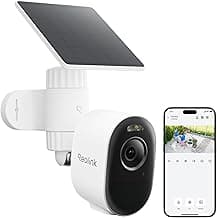
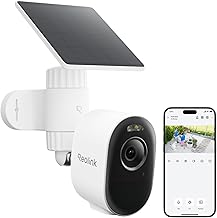
The Reolink Argus 4 Pro tackles the blind-spot problem differently. Rather than using mechanical motors that swivel to track movement, the Argus 4 Pro integrates dual 5MP lenses with real-time image stitching. This delivers an expansive, seamless 180-degree panoramic field of view with minimal edge distortion.
Night performance is a notable advantage here. Utilising Reolink's ColorX night-vision tech paired with a large F/1.0 aperture lens, the Argus 4 Pro captures full-colour video in extremely dim conditions without relying heavily on blinding white spotlights, though an integrated spotlight and siren are present when an intruder deterrent is needed.
The on-device AI handles person, vehicle, and animal detection without sending clips outside your local network. Storage flexibility is arguably the best in its class: rather than locking you to a proprietary ecosystem, the camera accepts microSD cards up to 512GB, connects to Reolink Home Hubs, and supports local FTP and NAS servers. Dual-band Wi-Fi 6 connectivity ensures rapid video streaming even when handling high-bitrate 5MP files.
- Key Strengths: Seamless 180° panoramic view without mechanical moving parts; high-end full-colour night vision in low ambient light; stable dual-band Wi-Fi 6; robust storage options (microSD up to 512GB, NAS, FTP).
- Key Compromises: No mechanical zoom or pan/tilt follow; battery operation means it is restricted to event-based recording rather than non-stop 24/7 continuous stream archiving.
- Who it is for: Anyone looking for wide, uninterrupted property line or garden coverage with superior night clarity and open storage options.
- Who should skip it: Those who need to read licence plates or zoom into distant targets past 15 metres, where a dedicated optical telephoto camera performs better.
Best for Smart Indoor Automation: Aqara Camera Hub G3
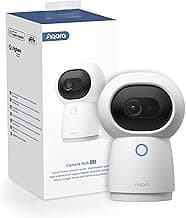
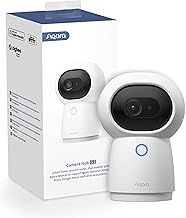
For indoor environments, the Aqara Camera Hub G3 represents the cutting edge of on-device vision processing. This compact 2K (2304 × 1296) indoor pan-and-tilt camera features an NPU that goes far beyond generic motion zones. It provides local facial recognition, pet tracking, abnormal sound detection (such as glass breaking or smoke alarms), and five distinct hand gesture recognition triggers.
Because the AI processing is performed locally on the G3's processor, facial recognition can be used to trigger complex home automations securely. For example, recognizing a family member's face can disarm an alarm, adjust smart lighting, and pan the camera physically into its mechanical privacy shield. The 5-gesture recognition feature allows you to control smart appliances simply by holding up a peace sign, an open palm, or an OK sign in front of the lens.
In addition to acting as a security camera, the G3 houses a built-in Zigbee 3.0 hub and an infrared blaster, enabling it to bridge dozens of smart home sensors and control legacy devices like air conditioning units. It also supports Apple HomeKit Secure Video, Amazon Alexa, and Google Assistant.
- Key Strengths: On-device facial recognition and unique gesture-controlled automations; integrated Zigbee 3.0 hub and IR controller; physical hardware privacy shutter; full Apple HomeKit Secure Video integration.
- Key Compromises: Strictly designed for indoor use only (not weather-resistant); requires a continuous mains power connection via USB-C.
- Who it is for: Smart home enthusiasts who want advanced indoor automation, facial-recognition-driven triggers, and a physical privacy shield when they are home.
- Who should skip it: Buyers searching for an outdoor, battery-powered perimeter camera.
Key Buying Criteria: How to Choose a Local AI Camera
1. True On-Device Processing vs Cloud AI
When selecting a camera, verify that the AI inference occurs on the camera's internal chipset or a dedicated local base station. Cameras that offload analysis to the cloud can suffer from a 2 to 6-second delay between a motion event and your phone pinging with an alert. True edge AI processes video frames within milliseconds, firing push notifications and audible sirens virtually the moment an event occurs.
2. Local Storage Formats and Redundancy
Ensure the hardware provides local storage you actually control. Common formats include:
- Internal eMMC Storage: Fast and tamper-resistant (as seen on the eufy S340), but limited in total capacity.
- microSD Card Slots: Inexpensive and easily expandable up to 512GB (as on the Reolink Argus 4 Pro).
- NAS / NVR / FTP Integration: Ideal for power users who want video backups stored across private home servers.
3. Power Delivery: Solar Freedom vs Mains Reliability
Battery and solar cameras have advanced significantly. High-efficiency solar panels require very little sunlight per day to maintain power, making installation straightforward on fences, sheds, and brickwork without drilling cable paths. However, battery cameras sleep until an infrared sensor or optical engine detects motion. If you require continuous 24/7 recording rather than event-driven clips, you will need a mains-wired camera or dedicated PoE (Power over Ethernet) system.
Alternatives to Consider
If you want a dedicated indoor alternative that keeps costs strictly in the budget tier, the Aqara Camera Hub G3 provides the deepest feature set under £100. For those seeking maximum perimeter coverage with zero moving mechanical components, the Reolink Argus 4 Pro offers an expansive 180-degree view that replaces the need to mount two separate static cameras side by side.
Final Verdict: Which Local AI Camera Should You Buy?
For comprehensive outdoor security, the eufy Security SoloCam S340 is our top recommendation. Its combination of 360-degree motorized tracking, 3K wide-angle framing alongside 8× telephoto zoom, reliable solar power, and on-device BionicMind AI delivers complete perimeter security with no subscription fees whatsoever. If indoor automation and Apple HomeKit integration are your main priorities, pick the Aqara Camera Hub G3 for its facial recognition and built-in Zigbee hub.