
As an Amazon Associate I earn from qualifying purchases. This page contains affiliate links, and I may earn a commission at no extra cost to you.
Parking surveillance is the primary reason many motorists install a dual-channel dash cam. Leaving your vehicle outside overnight on a residential street or in an airport car park brings justifiable anxiety about hit-and-run scrapes and vandalism. Yet modern vehicle electrical architectures make continuous parking recording surprisingly complicated.
If you drive a modern mild-hybrid (MHEV), full hybrid (HEV), electric vehicle (EV), or a conventional vehicle equipped with an aggressive stop-start system, your 12V auxiliary battery is under constant pressure. Unlike older cars with massive, forgiving starter batteries, newer vehicles monitor quiescent parasitic drain ruthlessly. Draw too much power while parked, and your dash cam will trip a low-voltage warning, shut down within four hours, or worse, leave the 12V battery depleted enough that the vehicle refuses to boot its onboard computers.
This head-to-head comparison breaks down two heavyweight contenders: the Check today's price on Amazon and the Check today's price on Amazon. Both offer flagship image sensors, but they approach the critical problem of 12V parking surveillance from fundamentally different engineering angles.
The Core Problem: Why Conventional Parking Mode Kills 12V Batteries
To understand why dash cams drain batteries so rapidly, consider standard buffered parking mode. In a typical optical motion-detection setup, the dash cam never truly sleeps. The image sensor, processor, and RAM stay fully powered, continuously buffering video into temporary memory. When visual movement or a G-sensor vibration occurs, the system writes the preceding five seconds and subsequent 20 seconds to the microSD card.
A dual-channel 4K front and 2K rear dash cam running optical buffered parking mode draws roughly 3.5 to 5.0 Watts of continuous power. On a standard 12V vehicle system, that translates to a sustained draw of roughly 300mA to 420mA. On a modest 45Ah to 60Ah battery—standard in modern compact cars and hybrids—this draw will trip a typical 12.0V or 12.2V low-voltage hardwire cut-off in roughly 8 to 16 hours. If your car sits unused over a rainy weekend, your parking surveillance stops protecting your car by Saturday afternoon.
Here is how the market leaders solve—or struggle with—this exact energy bottleneck.
Comparison Table: Parking Mode Power and Specs
| Product | Key Sensor & Tech | Parking Surveillance Mode | Price Band | Verdict | Action |
|---|---|---|---|---|---|
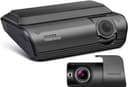
| Thinkware U3000 2CH Front and Rear Dash Cam | Sony STARVIS 2 IMX678 (4K) + IMX675 (2K) with Built-in mmWave Radar | Radar Standby (~50–80mA draw) & Energy Saving 2.0 | Premium | The ultimate zero-drain parking sentry for hybrids and EVs | Check today's price on Amazon |
| VIOFO A229 Pro 2CH Dual Dash Cam | Sony STARVIS 2 IMX678 (4K) + IMX675 (2K) with Quad-HD Rear & HDR | Auto Event Detection (Buffered), Low Bitrate, Time-Lapse | Mid-to-Premium | Unmatched video clarity, but requires strict cut-off limits | Check today's price on Amazon |
| BlackVue DR770X-2CH Dual Dash Cam | Sony STARVIS Full HD Front & Rear (60fps/30fps) with Built-in Voltage Cutoff | Intelligent Motion & Impact Detection, Time-Lapse | Premium | Sleek tube design with reliable native 12V voltage protection | Check today's price on Amazon |
| Nextbase 622GW Front Dash Cam | 4K UHD @ 30fps with Image Stabilisation & Polarising Filter | Intelligent Parking Mode (G-Sensor wake-up) | Mid-Range | Great daytime lens clarity with wake-on-bump battery mode | Check today's price on Amazon |
Deep Dive: Thinkware U3000 2CH
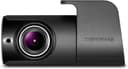
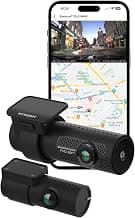
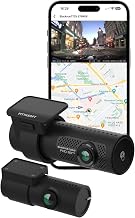
The Check today's price on Amazon is designed specifically around low-energy surveillance. While other brands handle parking recording by leaving optical sensors on, Thinkware integrates dedicated millimetre-wave (mmWave) radar modules directly into both the front and rear camera housings.
How Radar Parking Mode Works
In Radar Mode, the camera shuts down its power-hungry main video processing unit and image sensors entirely. Only the ultra-low-power radar transceiver remains active, sweeping the area around your front and rear bumpers. The current draw drops to roughly one-fifth of standard continuous recording—often under 80mA.
When the radar detects a moving object (such as a vehicle parking nearby or a pedestrian approaching), it immediately wakes up the main 4K Sony STARVIS 2 processor. If a physical impact occurs via the G-sensor, the camera secures a buffered video covering 10 seconds before the impact and 10 seconds after. If no impact happens, the camera smoothly returns to deep sleep without filling your memory card with hundreds of false-positive clips caused by wind-blown trees or passing headlights.
12V Battery Protection Features
- Configurable High Cut-off Limits: You can set the voltage cut-off threshold up to 12.4V via the mobile app, ensuring sensitive hybrid batteries are never depleted past safe limits.
- Winter Battery Protection: Automatically raises cut-off voltage thresholds during cold months when lead-acid and AGM chemistry is vulnerable to cold-cranking capacity loss.
- Extended Recording Duration: Vehicles parked long-term can achieve days or even weeks of active standby surveillance on a standard 12V battery before hitting voltage thresholds.
The trade-off is upfront cost. The U3000 sits at the upper end of the retail pricing spectrum. Furthermore, radar waves can be shielded slightly if your vehicle windscreen features heavy metallic thermal coatings, though side-glass and standard windscreens present no issue.
Deep Dive: VIOFO A229 Pro 2CH

The Check today's price on Amazon has earned a reputation among automotive enthusiasts for offering some of the crispest, most legible licence-plate video on the market. It pairs an 8MP Sony STARVIS 2 IMX678 front sensor with a 5MP Sony STARVIS 2 IMX675 rear sensor, backed by hardware-level High Dynamic Range (HDR) on both channels.
Parking Mode Mechanics and Drawbacks
While the A229 Pro dominates in moving video quality, its parking mode relies on traditional methods: Auto Event Detection (optical motion sensing with a 15-second pre-buffer), Low Bitrate Continuous Recording, or Time-Lapse. Because the image processors remain fully powered to analyse incoming video frames, the continuous current draw sits between 350mA and 450mA at 12V.
When wired to a vehicle using VIOFO's HK4 hardwire kit, you have physical dip switches to set your cut-off to 11.8V, 12.0V, 12.2V, or 12.4V. In practice, on modern vehicles with modest 12V batteries, setting the cut-off to a safe 12.2V or 12.4V means the A229 Pro will typically power down after 6 to 14 hours of parking. If you require 48 hours of constant coverage over a weekend, the A229 Pro will inevitably cut out early unless supported by an external dedicated LiFePO4 dash cam battery pack.
Image Quality Dominance
- True 4K Front + 2K Rear: Licences plates are legible even under harsh artificial street lighting or fast closing speeds.
- Dual HDR: Prevents blown-out white registration plates caused by intense headlight reflections at night.
- Faster 5GHz Wi-Fi: High-speed wireless data transfer makes pulling footage onto your phone straightforward.
Head-to-Head: Power Management and Real-World Scenarios
Scenario 1: Daily Commuter Parked on the Street Overnight (10–12 Hours)
If your car is parked for 10 hours overnight and driven for 45 minutes every morning and evening, both systems will perform well. The Check today's price on Amazon will deliver superior low-light plate readability, and your 45-minute commute will generally replenish the energy consumed by the 12V battery during that 10-hour window.
Scenario 2: Modern Hybrid or EV Left at an Airport for 5 Days
This is where the difference becomes stark. The VIOFO A229 Pro will hit its 12.2V safety threshold within the first 12 to 18 hours, powering down and leaving your car unmonitored for the remaining four days. By contrast, the Check today's price on Amazon in Radar Mode can easily survive 5 to 7 days on standard vehicle battery capacity, actively detecting movement around the car and retaining the ability to record impact events right up to the moment you return.
Alternatives to Consider
BlackVue DR770X-2CH Dual Dash Cam
For drivers who value discreet installation and cloud connectivity, the Check today's price on Amazon is a proven alternative. Unlike older models that required separate external power management modules, the DR770X features built-in voltage cut-off circuitry hardwired directly into its main power cable.
It captures smooth 1080p footage at 60fps front and 30fps rear using Sony STARVIS sensors. While its Full HD resolution does not match the 4K resolving power of the VIOFO or Thinkware, its cylindrical, screenless form factor sits invisibly behind your rear-view mirror, and its power draw in Time-Lapse parking mode is modest and stable.
Nextbase 622GW Front Dash Cam
If you prefer a front-only solution with top-tier driver safety integrations, the Check today's price on Amazon remains a strong standalone option. It delivers true 4K recording with an integrated rotating polarising filter to remove windscreen glare, paired with digital image stabilisation for uneven road surfaces.
For parking protection, Nextbase employs an Intelligent Parking Mode that puts the unit into a deep standby state using an internal G-sensor. The camera only powers up and records a 45-second clip when it detects a physical bump or knock. This draw is extremely low, though it lacks pre-buffered video—meaning you capture the aftermath of a bump rather than the seconds leading up to it.

Installation and Wiring Best Practices for 12V Protection
Whichever camera you choose, proper installation determines whether your 12V battery stays healthy:
- Never tap into critical vehicle safety circuits: Use fuse taps (add-a-circuit) on non-critical, accessory-switched fuses (like rear wiper motors or 12V accessory sockets) and constant-hot fuses (like hazard lights or door lock circuits) as specified by your vehicle's fuse diagram.
- Set your cut-off to 12.2V or 12.4V on modern vehicles: While older 12V lead-acid batteries could be drained to 11.8V and still turn an engine over, modern vehicles with complex electronic control modules (ECMs) often throw error codes or disable remote keyless entry if voltage drops below 12.0V.
- Avoid OBD-II power ports on hybrid powertrains: Some cheap OBD power cables bypass power-management systems or keep the vehicle's CAN-bus network awake, resulting in massive parasitic drain that shuts down parking mode in minutes. Dedicated hardwire kits connected to the internal fuse box remain the professional standard.
The Verdict: Which Dash Cam Should You Buy?
Both models represent the pinnacle of dual-channel dash cam technology, but they serve different priorities.
If your main goal is uncompromised multi-day parking surveillance without risking a flat 12V starter battery, the Check today's price on Amazon is the clear winner. Its integrated front and rear mmWave radar architecture represents the only genuine hardware solution to the parasitic drain problem, giving you days of reliable pre-buffered impact coverage where traditional cameras shut off in hours.
However, if your vehicle is driven daily and parked in a secure garage overnight, or if you plan to install a dedicated secondary battery pack, the Check today's price on Amazon offers noticeably superior moving dynamic range, crisper licence plate capture, and a lower initial purchase price.