As an Amazon Associate I earn from qualifying purchases. This page contains affiliate links, and I may earn a commission at no extra cost to you.
You have decided on screen-free audio for your child, and you have settled on the Yoto ecosystem because credit-card-sized story cards fit easily into wallets, pockets, and binders without taking up half a toy chest. The real dilemma happens at checkout: do you buy the tabletop Yoto Player (3rd Generation) or the pocket-sized Yoto Mini?
Both players access the exact same library of over 1,000 physical cards—ranging from Julia Donaldson classics to full Roald Dahl novels, podcasts, kid-safe radio, and blank Make Your Own (MYO) cards. Both eliminate cameras, microphones, and advertising entirely. Yet they serve two fundamentally different daily routines: one acts as a full-featured bedside companion and room hub, while the other is built specifically to withstand car seats, flights, and playground runs.
Quick Comparison: Specs and Daily Practicalities
Here is how the main hardware specifications and functional traits break down between the two sibling players and their primary alternatives.
| Product | Key Specs | Price Band | Best Everyday Role | Check Price |
|---|---|---|---|---|
| Yoto Player (3rd Generation) | 32GB storage (600+ hrs offline), up to 16h battery, room thermometer, nightlight, inductive charging | Mid-Range to Premium (£90–£100) | Bedside sleep routines & room audio hub | Check price on Amazon |
| Yoto Mini | 32GB storage, up to 14h battery, compact form factor, pixel screen, standard USB-C | Mid-Range (£55–£65) | Travel, car journeys, pram walks & independent portable play | Check price on Amazon |
| Tonies Toniebox Starter Set | Padded soft cube, figurine activation, durable pinch controls, 7h battery | Mid-Range (£75–£85) | Tactile play for toddlers under 4 | Check price on Amazon |
| Lunii My Fabulous Storyteller | No physical cards (wheel selection), interactive choose-your-own-path stories, headphone jack | Budget to Mid-Range (£50–£65) | Interactive audio adventures without loose media | Check price on Amazon |
Form Factor, Durability, and Portability
The visual distinction between these two models tells you almost everything about their intended home.
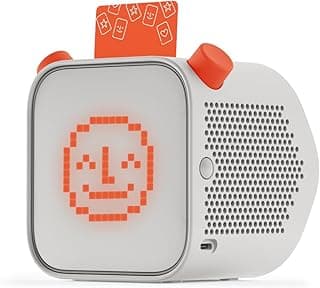
The Yoto Player (3rd Generation) is a soft-cornered tabletop cube measuring roughly 11 x 11 x 10.5 cm. It sits securely on a bedside table or shelf, angled slightly upward so a child lying in bed can clearly see the illuminated pixel art display and clock face. While it includes a built-in battery giving up to 16 hours of playback off the dock, its bulk and weight make it cumbersome for small hands to carry around the house for extended periods. It can be moved from room to room, but drops onto hard kitchen tile are high-stakes events unless you purchase an optional silicone Adventure Jacket.
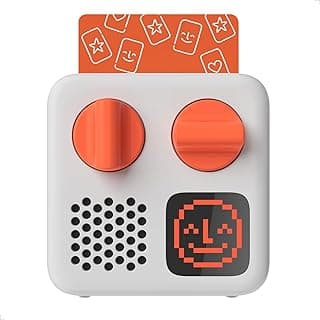
The Yoto Mini, by contrast, measures roughly 7 x 7 x 4 cm—small enough to fit into an adult palm or a child's coat pocket. At roughly a third of the weight of the full-sized Player, children routinely carry it by hand or wear it around their neck using a lanyard case. It slips effortlessly into backpack side pockets and sits flat on stroller trays or car seat armrests without sliding off around sharp corners. For families who spend weekends in transit, the Mini eliminates the logistical friction of packing a bulky appliance.
Bedside Features: Nightlights and OK-to-Wake Clocks
If your primary motivation is fixing bedtime routines or sleep hygiene, the 3rd Gen Player pulls ahead dramatically.
The full-sized player incorporates a dynamic nightlight around its perimeter. Turning the player face down on a nightstand automatically activates the ambient light, which parents can schedule to glow warm amber or soft red at night and switch to bright yellow or green at a chosen wake-up hour. It also houses an integrated room thermometer that reports temperature readings directly back to the parent smartphone app, helping you monitor whether a nursery is overheating or too chilly overnight.
The Yoto Mini does include a digital clock mode and basic sleep timers, but it completely lacks the room-illuminating nightlight ring and room thermometer. Its smaller, front-facing pixel screen can display a moon during sleep hours and a sun when it is time to get out of bed, but it will not light up a dark bedroom. If you buy the Mini for a child who is afraid of the dark, you will still need a separate nightlight on their nightstand.
Audio Quality and Speaker Output
A larger cabinet allows for significantly improved acoustics. The 3rd Generation Yoto Player delivers substantially richer, deeper audio with noticeable bass response compared to earlier iterations. While it is not intended to replace an audiophile Bluetooth speaker, it easily fills a medium-sized bedroom with clear spoken-word narration or lively party music without distorting at maximum volume.
The Yoto Mini's speaker prioritises vocal clarity over low-end thump. Spoken audiobooks, podcasts, and daily radio broadcasts come through crisp and articulate, which is what matters most for bedtime stories or car seat listening. However, music tracks can sound somewhat tinny at top volume. In practice, because the Mini is frequently paired with wired or Bluetooth headphones during travel, this acoustic difference rarely bothers young listeners on the go.
Controls, Storage, and Battery Performance
Both devices share identical, remarkably intuitive physical controls: two tactile, rubberised orange dials. Turning the left dial adjusts volume; turning the right dial skips tracks; pressing the right dial jumps directly into the free daily Yoto Daily podcast or Yoto Radio. A child simply inserts a plastic card into the top slot to trigger instant playback, and pulling the card out immediately pauses the track.
Under the hood, both units feature 32GB of internal storage capable of holding roughly 600 hours of audio for offline playback. When a new card is slotted in while connected to home Wi-Fi, the player automatically streams the track while downloading the entire audio file into its local cache in the background. Once downloaded, the card works instantly on aeroplanes, remote camping spots, or road trips without any data connection.
Battery endurance is strong on both: up to 16 hours on the 3rd Gen Player and up to 14 hours on the Mini. The 3rd Gen Player offers the added convenience of an optional magnetic wireless charging dock alongside standard USB-C fast charging, allowing a four-year-old to dock their own player without fumbling with cables.
Which Yoto Is the Right Gift?
Choosing between these two models comes down to identifying the single most persistent friction point in your child's weekly routine.
Choose the Yoto Player (3rd Generation) if:
- The device will live on a nightstand 80% of the time as a dedicated bedtime storyteller and sleep trainer.
- You want the integrated perimeter nightlight and OK-to-wake color changing clock to keep early risers in bed.
- You want room-filling sound for dance parties and shared family listening in the playroom.
- You prefer the ease of magnetic drop-and-charge docking for younger toddlers.
Choose the Yoto Mini if:
- Your child frequently travels, goes on long car rides, or attends after-school clubs where portable entertainment is required.
- You want a lower upfront price point while retaining full access to the entire 1,000+ card Yoto ecosystem.
- The child is between 6 and 12 years old and prefers using wired or Bluetooth headphones in their personal space.
- You already have a dedicated nightlight or clock in the bedroom.
Alternatives to Consider
If you are not entirely convinced the card-based Yoto system is the right fit, two established competitors offer distinct approaches to screen-free children's audio.
Tonies Toniebox Starter Set
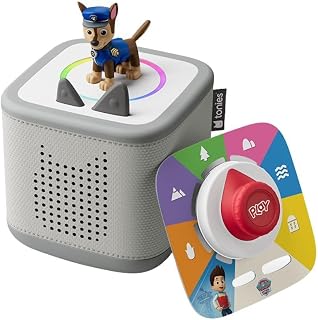
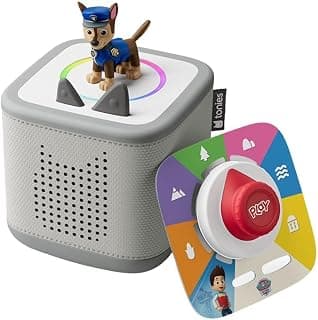
The Tonies Toniebox Starter Set remains the heavyweight alternative for toddlers aged 1 to 4. Instead of thin plastic cards, audio is triggered by placing solid, hand-painted magnetic figurines (Tonies) onto a padded, fabric-wrapped cube. The player is built like a soft tank—it survives being thrown down staircases, and children adjust volume by squeezing the rubberised "ears" on top. However, Tonie figurines are significantly more expensive per hour of content, take up substantial space in diaper bags, and tend to appeal less to children once they reach ages 7 or 8.
Lunii My Fabulous Storyteller
For parents who want to avoid physical media entirely, Lunii My Fabulous Storyteller takes an interactive, choose-your-own-adventure route. Children turn physical selection wheels to pick a hero, a setting, a supporting character, and an object, and the device immediately weaves an original audio story based on those choices. It is lightweight, durable, includes a headphone jack, and eliminates the risk of losing plastic cards under sofa cushions, making it a compelling travel device for ages 3 to 8.