As an Amazon Associate I earn from qualifying purchases. This page contains affiliate links, and I may earn a commission at no extra cost to you.
It's 2026, and the world of educational robotics continues to evolve at a rapid pace. If you're past the absolute basics of block coding and ready to tackle more complex projects, choosing the right intermediate coding robot can feel like a labyrinth. You want something engaging, robust, and capable of growing with your learner, without breaking the bank or overwhelming them with unnecessary complexity. We're looking at three major players today: the refreshed Makeblock mBot (2023 Edition), its more powerful sibling, the Makeblock mBot Neo, and the highly regarded LEGO Education SPIKE Prime. Each offers a distinct approach to learning, blending hardware and software in unique ways to foster crucial STEM skills.
Finding the sweet spot for intermediate learners means striking a balance. A robot that's too simple will quickly bore, while one that's too advanced can lead to frustration. The ideal kit provides a solid foundation in programming logic, introduces concepts like sensor interaction and control systems, and encourages creative problem-solving. Let's break down what each of these popular coding robots brings to the table, so you can confidently pick the one that's genuinely right for your budding engineer or coder.
Makeblock mBot (2023 Edition): The Refined Classic for Structured Learning
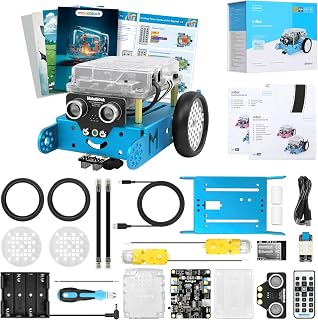
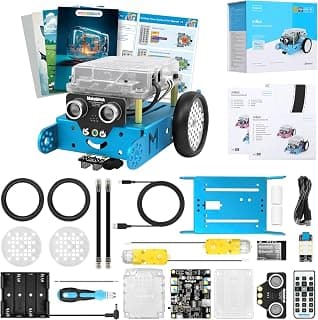
The Makeblock mBot (2023 Edition) represents the latest iteration of a hugely popular entry-level coding robot, now with refinements that make it even more accessible and engaging. While it's often positioned as a beginner robot, its versatility, especially when combined with expansion packs, allows it to easily bridge the gap into intermediate concepts. It's built on an open-source platform, offering a lot of flexibility for those who want to dig deeper.
Design and Build Quality
The mBot's design remains largely consistent with its predecessors: a sturdy aluminum chassis, simple assembly, and a clear, kid-friendly aesthetic. The 2023 Edition maintains this robust feel, designed to withstand the inevitable bumps and drops that come with active learning. It’s easy to assemble, usually taking less than 30 minutes, which is a big plus for getting started quickly. The colour-coded RJ25 ports are a thoughtful touch, simplifying the connection of various sensors and modules without confusing wires. This simplicity belies a surprising durability, based on widespread owner feedback; it truly feels built to last through many projects.
Key Features and Expandability
At its core, the mBot (2023 Edition) features a main control board (based on Arduino Uno), two motors, an ultrasonic sensor, a line-follower sensor, and an integrated light sensor. Its primary programming interface is mBlock, Makeblock's visual block-based programming environment, which is derived from Scratch. This provides an intuitive drag-and-drop experience. For intermediate users, mBlock also allows for seamless switching to Python code, which is a fantastic bridge to text-based programming. What really makes the mBot shine for intermediate learners is its expandability. The open-source nature means a vast array of additional Makeblock modules and even third-party components can be integrated, allowing for increasingly complex projects like robotic arms, voice-controlled cars, or even simple IoT devices. Bluetooth connectivity is standard, allowing for wireless control and programming from a tablet or PC.
Performance and Learning Curve
Based on published specs and numerous owner reports, the mBot (2023 Edition) performs reliably. Its motors are responsive, and the sensors generally provide accurate data for basic tasks. The learning curve is gentle for beginners, but the transition to Python within the mBlock environment provides a natural progression for intermediate users. This dual-language support is a significant advantage, allowing learners to consolidate block-coding logic before translating it into a more professional text-based language. It’s not the fastest or most agile robot, but for learning core programming and robotics concepts, its performance is more than adequate. Projects can range from simple line-following to obstacle avoidance, and with additional sensors, the possibilities expand significantly.
Value Proposition
Priced squarely in the budget to mid-range segment, the mBot (2023 Edition) offers excellent value for money. It provides a solid entry point into robotics with a clear upgrade path to more advanced programming. The availability of numerous online resources, community support, and Makeblock's own educational content further enhances its appeal. It's an investment that pays dividends through sustained engagement and skill development, making it a smart choice for many.
Makeblock mBot Neo: The Next Evolution for Advanced Intermediate Coders
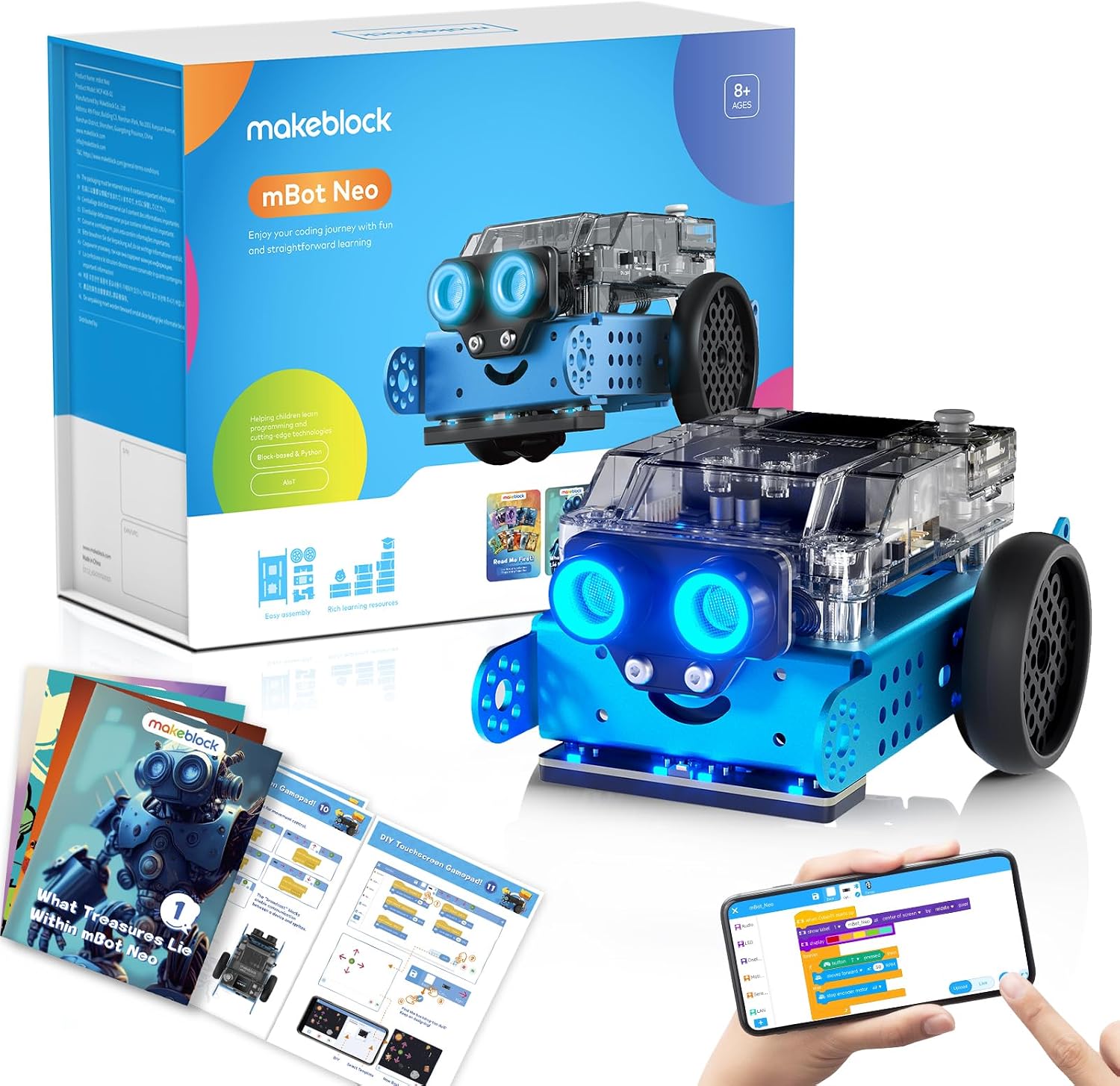
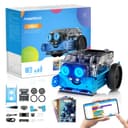
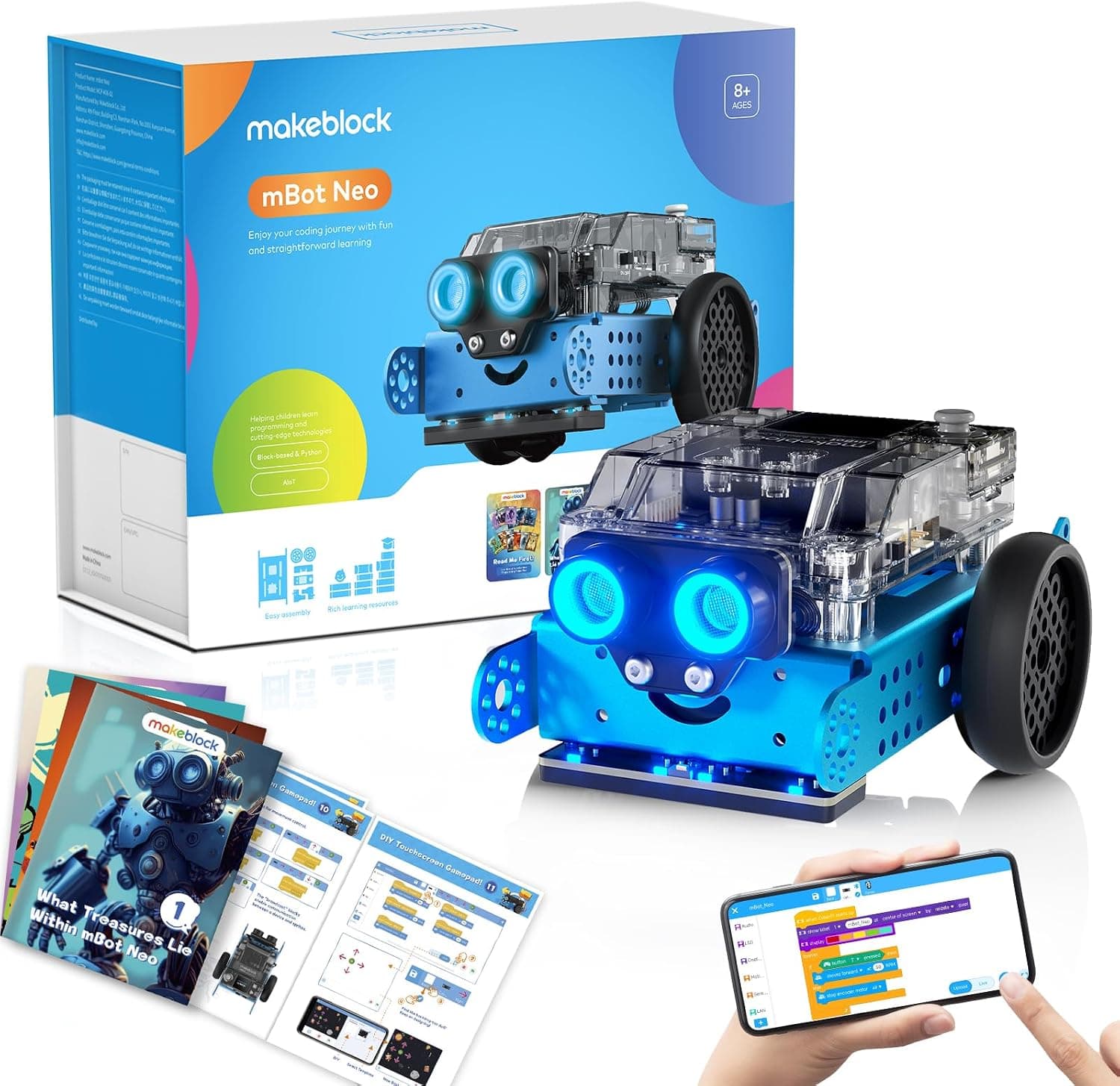
The Makeblock mBot Neo is not just an upgrade; it's a significant leap forward from the classic mBot, designed specifically for users ready to dive into more sophisticated robotics and coding challenges. It retains the friendly Makeblock ecosystem but packs considerably more power and features under its hood, making it a fantastic choice for pushing beyond basic line-following.
Design and Build Quality
Like its sibling, the mBot Neo sports a robust, durable aluminum alloy chassis. However, it feels more substantial and refined. The modular design is still present, but the integration of components like its powerful mainboard (CyberPi) gives it a sleeker, more professional look. Assembly is still straightforward, leveraging the same colour-coded RJ25 ports, which means fewer frustrations with wiring. Reviewers and owners commonly report that the Neo feels more 'premium' than the standard mBot, capable of handling more rigorous educational environments and ambitious projects.
Key Features and Expandability
Here’s where the mBot Neo really differentiates itself. It's powered by the CyberPi main control board, which is a beast compared to the mBot’s board. The CyberPi features Wi-Fi and Bluetooth connectivity, a full-color display, a speaker, and a built-in microphone, opening up possibilities for IoT projects, speech recognition, and richer interactive experiences. It includes an ultrasonic sensor, line-follower, and a new 'quad RGB sensor' that offers improved colour detection and line-following capabilities. The mBot Neo natively supports both mBlock (Scratch-like blocks and Python) and even Arduino C, making it incredibly versatile for intermediate to advanced programming. The Wi-Fi connectivity is a game-changer, enabling cloud-based programming, multi-robot communication, and a host of online data-driven projects that aren't possible with the standard mBot. The expandability remains excellent, compatible with the full range of Makeblock modules.
Performance and Learning Curve
The mBot Neo delivers significantly enhanced performance. Its more powerful motors, combined with a more advanced control board, allow for smoother, more precise movements and more complex algorithms. Based on specifications and user feedback, the integrated sensors are more accurate and reliable, which is crucial for advanced autonomous behaviours. The learning curve for the Neo is steeper than the original mBot but perfectly pitched for intermediate learners who have some prior coding experience. The jump to Wi-Fi functionality and advanced sensors means a richer problem-solving experience. It’s designed to handle more intricate programming challenges, from complex navigation routines to data logging and IoT integrations, pushing learners towards true innovation.
Value Proposition
The mBot Neo sits in the mid-range to premium segment, and it absolutely justifies its price tag. The combination of the powerful CyberPi board, enhanced sensors, and Wi-Fi capabilities makes it a highly capable platform for serious STEM education. It’s a robot designed to challenge and inspire, providing a robust ecosystem for learners ready to transition from basic concepts to applied robotics and coding. For those truly committed to developing advanced intermediate skills, the investment in the mBot Neo will provide a much richer and more capable learning experience than a simpler robot.
LEGO Education SPIKE Prime: The Premium Choice for Integrated Learning
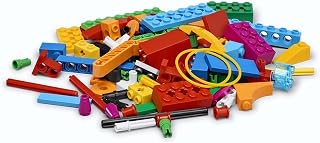
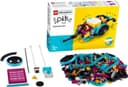
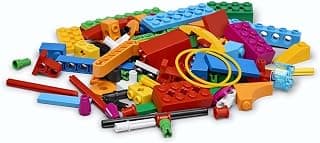
The LEGO Education SPIKE Prime system marries the beloved tactile building experience of LEGO with a powerful, educational robotics platform. It's designed specifically for classroom and structured learning environments, often used from primary school all the way through secondary, making it an excellent, albeit premium, choice for intermediate STEM skill development.
Design and Build Quality
Unsurprisingly, the build quality is classic LEGO: incredibly durable, precisely engineered, and designed for countless hours of rebuilding. The core of SPIKE Prime is its Hub, a brick-shaped control unit with 6 input/output ports, a 5x5 LED matrix, a speaker, and a 6-axis gyro sensor. It connects seamlessly with LEGO Technic elements, allowing for an incredible array of customisable robot designs. The robust nature of LEGO bricks means that robots built with SPIKE Prime are incredibly sturdy, and the tactile nature of physical construction helps reinforce engineering principles alongside coding. Reviewers consistently praise its robust design, which is a major advantage in busy educational settings where durability is key.
Key Features and Expandability
SPIKE Prime features a sophisticated collection of sensors and motors: a force sensor, distance sensor, colour sensor, and three powerful motors. The Hub itself provides Bluetooth connectivity, enabling wireless programming and control. The programming environment is a modified Scratch 3.0, offering an intuitive block-based interface that is incredibly rich in functionality. For intermediate learners, this Scratch-based environment supports complex logic, data handling, and custom block creation, allowing for very sophisticated programs. While it doesn't offer direct Python integration in the same way mBlock does, its Scratch environment is incredibly deep and capable. The true expandability comes from the vast universe of LEGO Technic parts; learners aren't limited to a pre-designed robot but can construct almost anything they can imagine, which is a huge advantage for creative problem-solving and engineering challenges. There's also a large online community and extensive curriculum resources from LEGO Education itself.
Performance and Learning Curve
Based on extensive educational use and owner feedback, SPIKE Prime offers exceptional performance. The motors are powerful and precise, capable of accurate movement and manipulation. The sensors are reliable and highly responsive, crucial for advanced autonomous behaviours. The integrated 6-axis gyro sensor in the Hub is a particular highlight, enabling precise motion control and balance projects. The learning curve is smooth for anyone familiar with LEGO building, and the block-based coding environment is easy to pick up. For intermediate users, the challenge comes from designing complex physical models and then programming them to perform intricate tasks, which fosters a holistic approach to STEM. It excels in scenarios requiring iterative design, robust mechanics, and detailed programming logic.
Value Proposition
The SPIKE Prime is undoubtedly the most premium option on this list, reflecting its comprehensive design, robust components, and extensive educational support. While the initial outlay is higher, the investment provides a highly integrated and durable learning system. It’s often used in classrooms for multi-year curricula, which speaks to its longevity and depth. For those who value the LEGO building experience, a robust and curriculum-aligned platform, and a system designed for collaborative learning, SPIKE Prime represents a top-tier choice for intermediate robotics and coding education.
Coding Robot Kit Comparison
Let's put these three fantastic robots side-by-side to highlight their core differences:
| Product | Age Range (Suggested) | Coding Language(s) | Connectivity | Price Band | Verdict | Buy |
|---|---|---|---|---|---|---|
| Makeblock mBot (2023 Edition) | 8+ years | Block (Scratch-like), Python | Bluetooth | Budget to Mid-Range | Great value, solid foundation for transitioning to Python. | Check today's price on Amazon |
| Makeblock mBot Neo | 10+ years | Block (Scratch-like), Python, Arduino C | Wi-Fi, Bluetooth | Mid-Range to Premium | Powerful, feature-rich, ideal for advanced IoT projects. | Check today's price on Amazon |
| LEGO Education SPIKE Prime | 10+ years | Block (Scratch-based) | Bluetooth | Premium | Unmatched build flexibility and integrated curriculum support. | Check today's price on Amazon |
Who Should Buy Which Robot?
Choose the Makeblock mBot (2023 Edition) if...
You're looking for an affordable, robust robot to introduce programming fundamentals and provide a smooth transition to Python. It’s perfect for learners who might have played with simpler block coding before and are ready for their first hands-on robotics kit, or for educators on a tighter budget who want a reliable, extensible platform.
Choose the Makeblock mBot Neo if...
Your learner is ready for more advanced challenges, particularly those involving Wi-Fi connectivity, IoT, and more complex sensor interactions. The CyberPi board is a significant upgrade, offering richer possibilities for data logging, cloud integration, and sophisticated programming. It's the robot for someone serious about exploring beyond the basics, offering a truly powerful platform for intermediate and even early advanced projects.
Choose the LEGO Education SPIKE Prime if...
You prioritise tactile building, robust mechanical design, and a highly integrated educational ecosystem. Its LEGO Technic compatibility offers unparalleled creative freedom in robot design, making it fantastic for open-ended engineering challenges. It's an excellent choice for structured learning environments, classrooms, or learners who thrive on physical construction alongside coding, and for those who appreciate the vast support and curriculum available from LEGO Education.
Alternatives to Consider
While the three main contenders cover a lot of ground, sometimes you might be looking for something a bit different. If you need a more entry-level, screen-free option or something that focuses more on playful interaction, consider the Dash Robot by Wonder Workshop. Dash is a highly engaging, pre-assembled robot that uses a block-based visual programming app to teach coding concepts through playful challenges and games. It’s fantastic for younger intermediate learners (ages 6-10) who might not be ready for assembly or complex text-based coding but still want to explore robotics with immediate feedback. It's durable, has a friendly personality, and offers a fun way to learn without the mechanical complexity of the other options.
Verdict
For intermediate STEM skills, the Makeblock mBot Neo stands out as the most balanced and forward-looking option, offering a powerful blend of robust hardware, advanced connectivity, and versatile programming options without the premium price tag of a full LEGO Education kit. Its CyberPi board and Wi-Fi capabilities truly open up new avenues for learning, making it an excellent investment for sustained educational growth.
Ultimately, the best coding robot kit is the one that aligns with the learner's existing skills, future aspirations, and your budget. Each of these robots offers a unique pathway to mastering crucial STEM concepts. Weigh your options, consider the learning style, and empower your intermediate coder to build, program, and innovate!